Infundibulum of gallbladder (Latin: infundibulum vesicae biliaris)
Also called Hartmann's pouch (when it bulges)
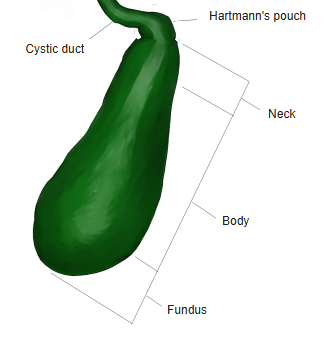
· When the wall of the infundibulum bulges outwards as a small pouch, usually towards the duodenum, the bulge is called Hartmann's pouch.
· Gallstones often collect here, so this part is often where cholecystitis and gallstone disease start. A large stone here can press on the nearby common hepatic duct and cause jaundice (Mirizzi syndrome).
· When the gallbladder is removed (cholecystectomy), it is important to know the exact shape of this part.
· The infundibulum is not always clearly seen, and its shape varies a lot between people.
· For this reason some anatomy books describe it and others do not, but in clinical work (especially surgery and endoscopy) it is often regarded as important. Sources also differ in naming: some use "infundibulum" and "Hartmann's pouch" as the same thing, some count the infundibulum as part of the neck, and some regard Hartmann's pouch as a change caused by disease rather than normal anatomy.
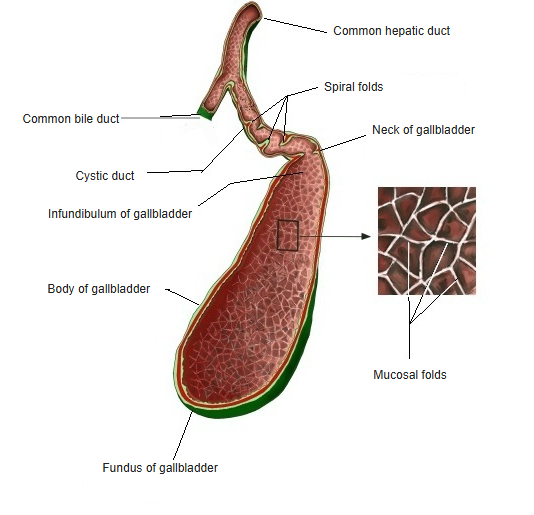
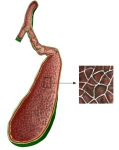 Inner surface of the gallbladder
 Parts of the gallbladder
Reference websites
[Wikipedia]
· Gallbladder, Wikipedia.
· Mirizzi's syndrome, Wikipedia.
[Websites with illustrations]
· The gallbladder and biliary tree (TeachMeAnatomy)
· Gallbladder: function, anatomy and histology (Kenhub)
· Gallbladder (illustration) (Wikimedia Commons)

Where it is found
Related terms
- Neck of gallbladder
- Body of gallbladder
- Fundus of gallbladder
- Cystic duct
- Common hepatic duct
- Gallbladder
References and sources
- Further reading: Gallbladder, Wikipedia.
- Further reading: Mirizzi's syndrome, Wikipedia.
- Federative International Programme for Anatomical Terminology (FIPAT). Terminologia Anatomica, 2nd ed. (TA2), 2019.