Cystic duct (Latin: ductus cysticus)
Note: some anatomy texts count the cystic duct as part of the gallbladder; most describe it as one of the extrahepatic bile ducts.
· It is about 3–4 cm long (sources give 2–4 cm) and runs backwards, downwards and to the left from the neck of the gallbladder, in the hepatoduodenal ligament.
· Its mucosa forms a row of crescent-shaped folds arranged in a spiral, the spiral fold (valve of Heister).
· Bile flows through it in both directions: into the gallbladder between meals, to be stored and concentrated, and out of the gallbladder after a meal, when the gallbladder contracts.
· It usually joins the right side of the common hepatic duct just above the duodenum, but the level and the way it joins vary a lot (it may run alongside the hepatic duct or spiral around it before joining).
· With the common hepatic duct and the inferior surface of the liver it bounds the cystohepatic triangle (Calot's triangle), which contains the cystic artery. This is an important landmark when the gallbladder is removed.
ducts
- Intrahepatic bile ducts
- In the hepatic lobule
- Bile canaliculus : the finest channel, with no wall of its own (a groove between liver cells).
- Canal of Hering : links the channels in the lobule with the interlobular bile ducts.
- Bile ductule : lined by flat bile-duct epithelial cells (cholangiocytes). The order of these two is given the other way round in some sources.
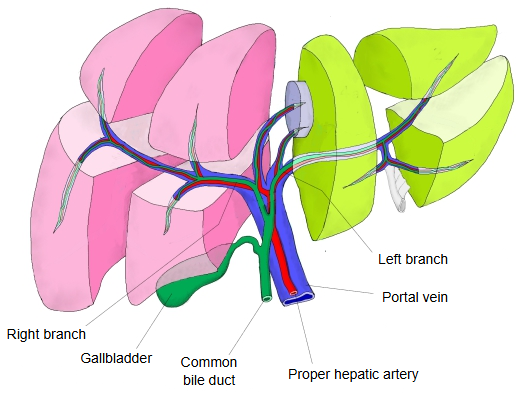
- Interlobular bile duct : receives the bile from the lobules; one of the three elements of the portal triad.
- Segmental bile ducts : collect the bile of the interlobular ducts segment by segment.
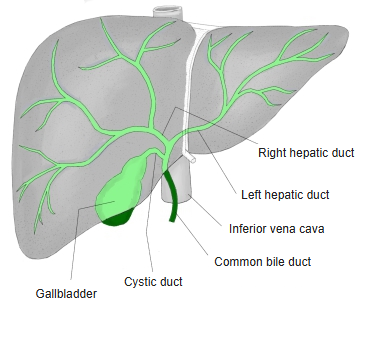
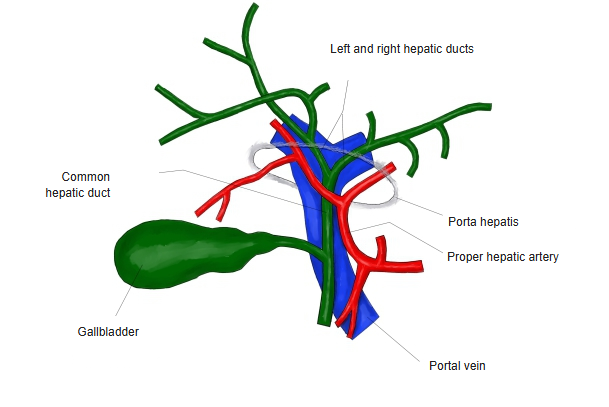
- Right / left hepatic duct : collect the bile of the segmental ducts of the right and left parts and leave the liver at the porta hepatis.
- In the hepatic lobule
- Extrahepatic bile ducts
- Common hepatic duct : formed by the union of the right and left hepatic ducts. Length about 2–4 cm.
- Cystic duct : carries the bile of the common hepatic duct to the gallbladder (and back). Length about 2–4 cm.
- Common bile duct : finally carries the bile made in the liver into the duodenum. Length about 6–8 cm.
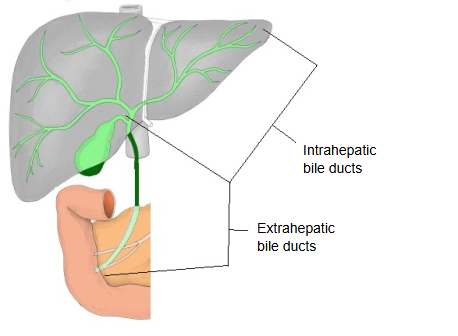
The figure below shows simply the path of bile from where it is made to where it leaves.
The path of bile
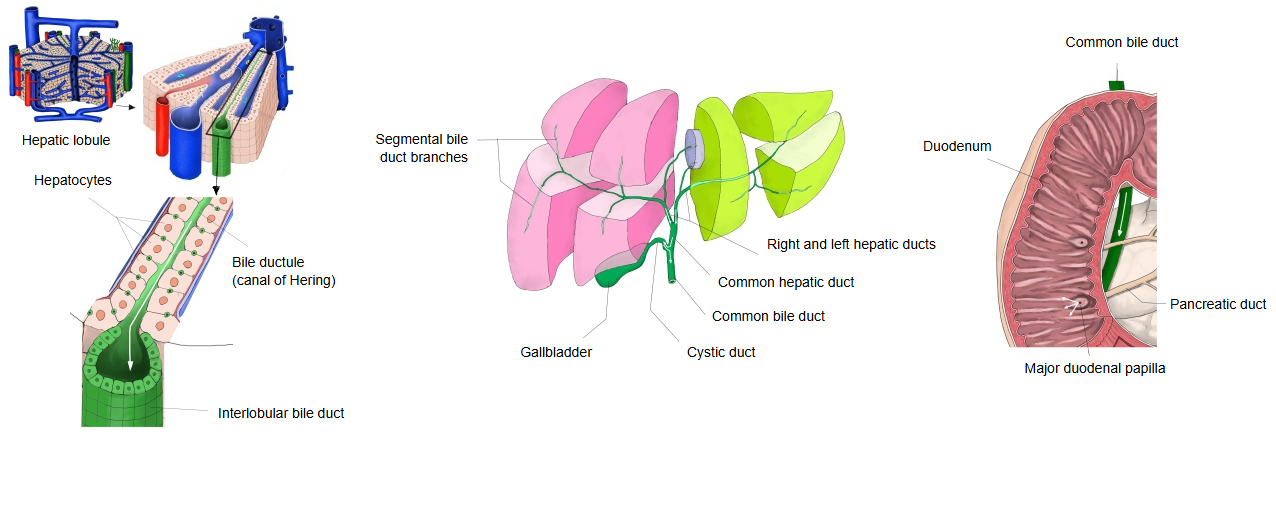
 Bile ducts of the liver
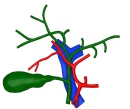 Ducts and vessels at the porta hepatis
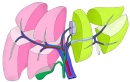 Hepatic segments and portal triad
Where it is found
Related terms
- Common hepatic duct
- Common bile duct
- Neck of gallbladder
- Hepatoduodenal ligament
- Porta hepatis
- Gallbladder
- Cystic veins
References and sources
- Further reading: Cystic duct, Wikipedia.
- Further reading: Cystohepatic triangle, Wikipedia.
- Federative International Programme for Anatomical Terminology (FIPAT). Terminologia Anatomica, 2nd ed. (TA2), 2019.