Intertrochanteric crest (Latin: crista intertrochanterica)
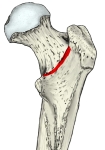 Right femur, upper end (posterior)
 Right femur (posterior)
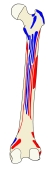 Muscle attachments (posterior)
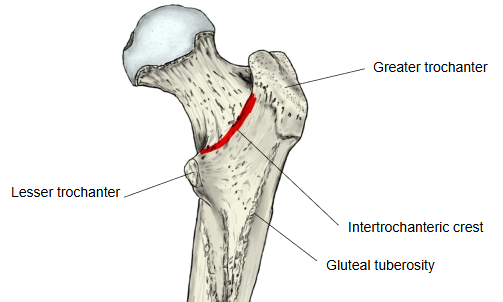
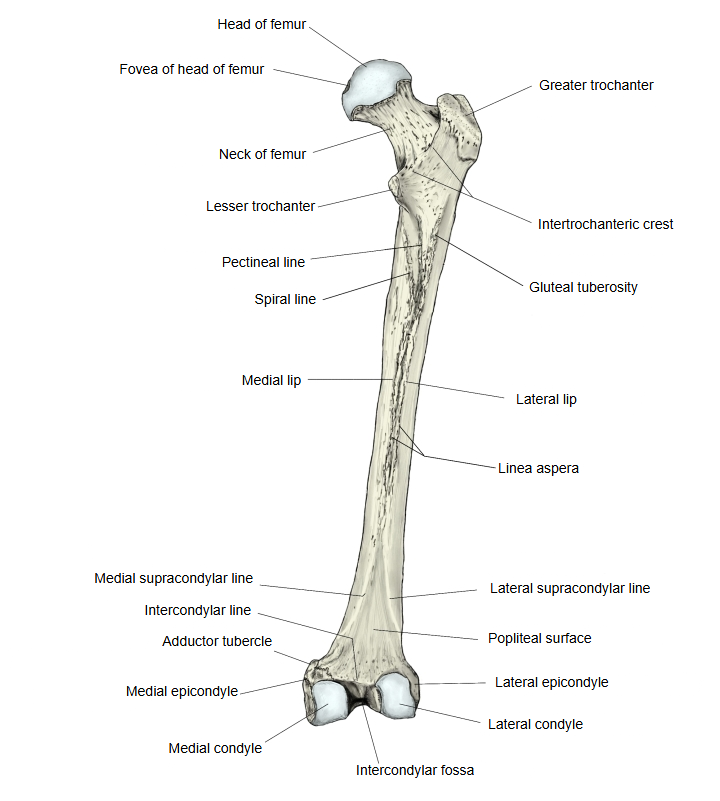
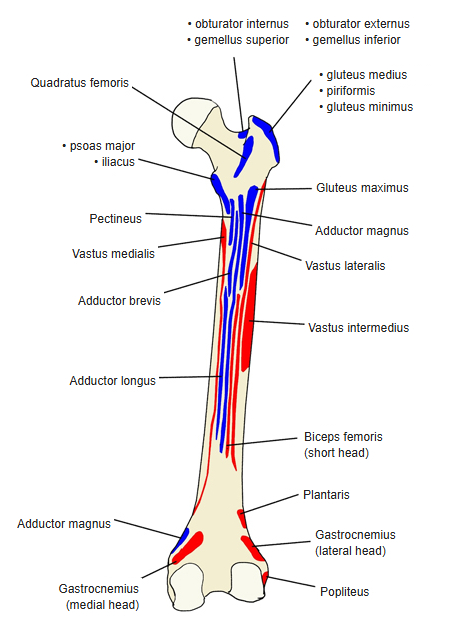
It is a smooth, rounded ridge running down and medially, and marks the back of the junction between the neck and the shaft. Its upper half forms the posterior border of the greater trochanter, and the trochanteric fossa lies just medial to its upper end. A low swelling a little above its middle, the quadrate tubercle, receives quadratus femoris. Unlike the front of the femur, the capsule of the hip joint does not reach the crest behind; it is attached to the neck about a finger's breadth medial to it. The intertrochanteric line is the matching, less prominent ridge on the front.
Attachments
| Muscle | 1 | Quadratus femoris (insertion, on the quadrate tubercle) | musculus quadratus femoris |
Reference websites
[Wikipedia]
· Intertrochanteric crest, Wikipedia.
· Quadratus femoris muscle, Wikipedia.
[Websites with illustrations]
· Upper end of the femur, posterior view (Wikimedia Commons)

· Right femur, posterior surface (Gray's Anatomy, fig. 245) (Wikimedia Commons)

· The femur (TeachMeAnatomy)
Where it is found
Related terms
- Quadrate tubercle
- Greater trochanter
- Lesser trochanter
- Intertrochanteric line
- Trochanteric fossa
- Neck of femur
- Hip joint
References and sources
- Further reading: Intertrochanteric crest, Wikipedia.
- Further reading: Quadratus femoris muscle, Wikipedia.
- Federative International Programme for Anatomical Terminology (FIPAT). Terminologia Anatomica, 2nd ed. (TA2), 2019.