Metopic suture (Latin: sutura metopica)
Also called the frontal suture
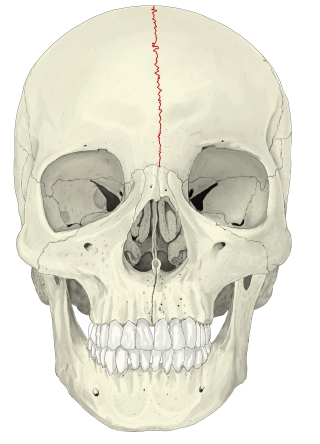
The suture in the midline of the forehead between the two halves of the frontal bone in the infant skull. It runs down the frontal squama from the anterior fontanelle (later the bregma) to the nasion, passing through the glabella.
· It is normally the first skull suture to close, so that the frontal bone becomes a single bone in early childhood. Sources differ on the timing: it often begins to close within the first year and is usually gone by about 2 years, though some older texts give 5 to 8 years.
· In a minority of adults (a few per cent) it stays open, wholly or in part, so that the frontal bone remains in two halves; this is called metopism. A short remnant just above the nasion is common.
· Premature fusion of this suture (metopic craniosynostosis) gives a keel-shaped, triangular forehead (trigonocephaly).
· On an X-ray, a persistent metopic suture should not be mistaken for a fracture.
Where it is found
Related terms
References and sources
- Further reading: Frontal suture, Wikipedia.
- Further reading: Trigonocephaly, Wikipedia.
- Federative International Programme for Anatomical Terminology (FIPAT). Terminologia Anatomica, 2nd ed. (TA2), 2019.