Muscular artery
Also called the distributing artery or the medium-sized artery
The distributing artery is another name for the muscular artery.
A muscular artery is an artery with a well-developed layer of smooth muscle in its tunica media; it is built for sending blood on to the periphery.
Tunica media: the middle layer of the wall of a blood vessel
Arteries of small to medium size are muscular arteries: most of the arteries that have their own names ("... artery"), such as the brachial, radial, femoral, coronary and renal arteries.
Because they regulate the flow of blood to the periphery, they are also called distributing arteries; their diameter differs greatly between contraction and relaxation of the muscle.
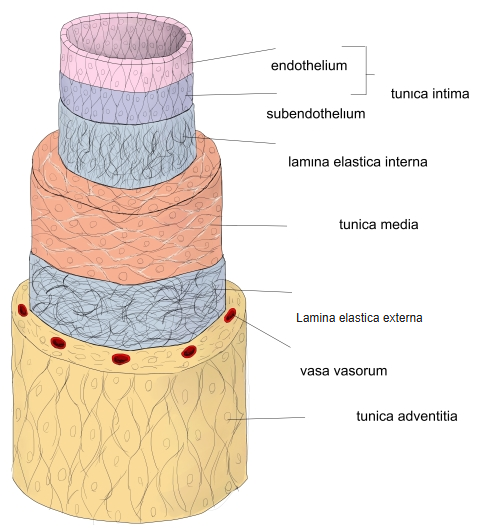
Wall: a thick internal elastic lamina lies between the tunica intima and the tunica media, and a thin external elastic lamina between the tunica media and the tunica adventitia. Within the tunica media itself no elastic laminae are formed; there are only scattered elastic fibres between many layers of smooth muscle. This is the main difference from the elastic arteries near the heart, whose media consists of many fenestrated elastic membranes.
Muscular arteries lie between the elastic arteries and the arterioles, the resistance vessels, in the arterial tree.
Related terms
- Resistance vessel
- Tunica adventitia
- Smooth muscle
- Vessel
- Structure of blood vessels
- Fenestrated elastic membrane
References and sources
- Further reading: Muscular artery, Wikipedia.
- Further reading: Artery, Wikipedia.
- Federative International Programme for Anatomical Terminology (FIPAT). Terminologia Anatomica, 2nd ed. (TA2), 2019.