Node of Ranvier
Also called the node of a myelinated nerve fibre or the plural nodes of Ranvier
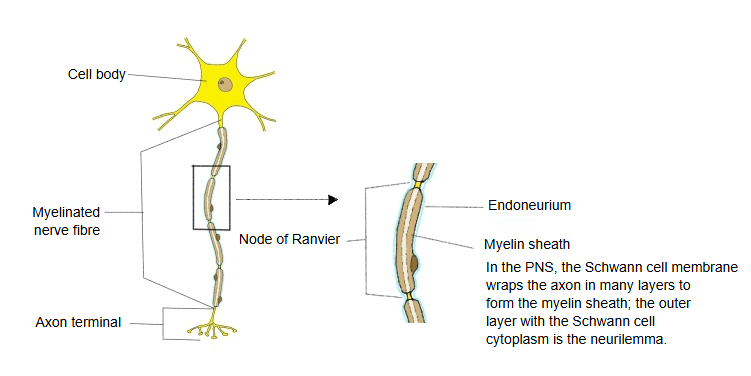
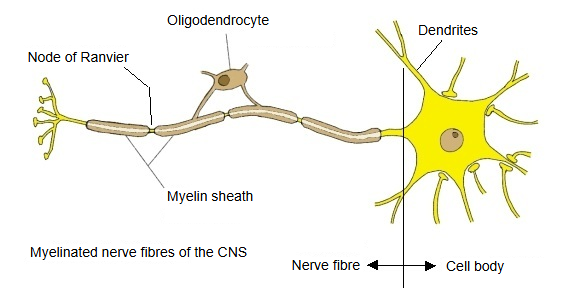
The table gives typical differences (sources differ in the details). In the central nervous system the myelin is made by oligodendrocytes; in the peripheral nervous system by Schwann cells, one cell for each internode.
| Central nervous system | Peripheral nervous system | ||
| 1 | Structure | Compact, tight | Relatively wide, distinct |
| 2 | Surrounding supporting cells | Often contacted by processes of astrocytes | Next to the cytoplasm (processes) of the Schwann cells; the endoneurium and basal lamina cover the whole fibre, including the node |
| 3 | Repair and regeneration | Very poor (regeneration is difficult) | Good (damaged fibres can regenerate) |
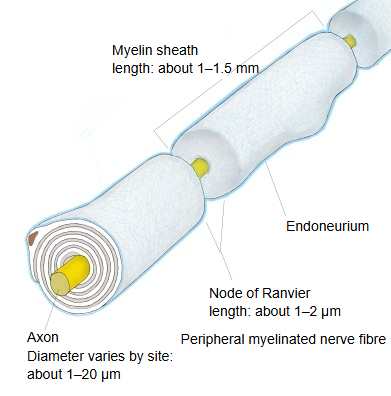
| 4 | Width of the node | About 1 µm | About 1–2 µm |
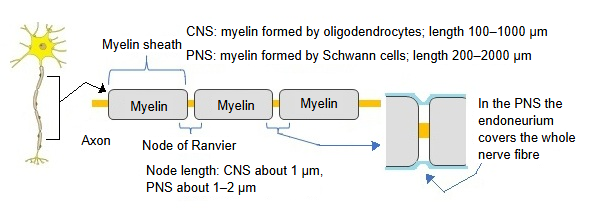
| Myelin sheath | + Node of Ranvier | ⇒ Saltatory conduction |
|---|---|---|
| · An insulator: a stack of fatty membranes. · The axon under the myelin has almost no ion channels. = ions cannot pass in or out = the electrical signal hardly leaks away ⇒ fast conduction. | · Voltage-gated ion channels (sodium and potassium channels) are packed densely here. · The action potential (electrical signal) is generated here. | · When the nerve is stimulated, the sodium channels open, sodium ions flow in and the membrane potential changes (= an action potential). · This electrical change passes quickly under the myelin to the next node of Ranvier. · Conduction is roughly 10 to several hundred times faster than in an unmyelinated fibre, and uses less energy. |
The node is named after the French histologist Louis-Antoine Ranvier, who first described it in 1871 and gave a fuller account in his 1878 lectures on the histology of the nervous system.
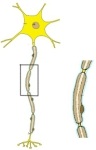 Myelinated nerve fibre (PNS)
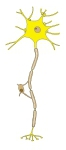 Myelinated nerve fibre (CNS)
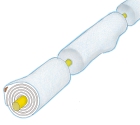 Peripheral myelinated fibre (3-D)
Reference websites
[Wikipedia]
· Node of Ranvier, Wikipedia.
· Saltatory conduction, Wikipedia.
[Websites with illustrations]
· Multipolar neuron with myelin sheath and nodes of Ranvier (Wikimedia Commons)

· Neuron with oligodendrocyte and myelin sheath (Wikimedia Commons)

· Saltatory conduction (animation) (Wikimedia Commons)

Related terms
References and sources
- Further reading: Node of Ranvier, Wikipedia.
- Further reading: Myelin, Wikipedia.
- Federative International Programme for Anatomical Terminology (FIPAT). Terminologia Anatomica, 2nd ed. (TA2), 2019.