Schwann cell (Latin: neurolemmocytus)
Also called the neurolemmocyte
(glial cells)
- Central nervous system
- Ependymal cell : lines the ventricles, the choroid plexus and the central canal; takes part in the production and flow of cerebrospinal fluid.
- Astrocyte : star-shaped, with many processes; the most numerous glial cell of the central nervous system.
- Oligodendrocyte : one cell wraps its processes around several axons and forms their myelin sheaths.
- Microglia : about 5–20% of the glial cells of the central nervous system; phagocytic.
- Peripheral nervous system
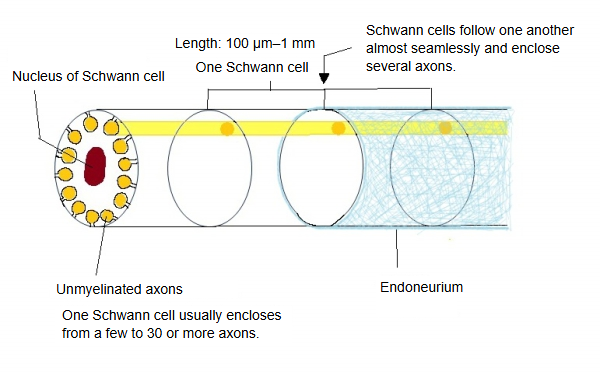
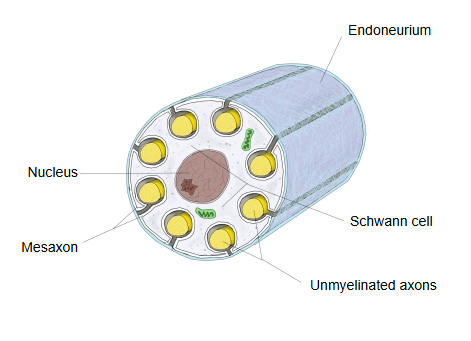
- Schwann cell : around myelinated fibres it forms the myelin sheath; around unmyelinated fibres it only covers the axons. In myelinated fibres one cell serves one axon.
- Satellite cell : surrounds the nerve cell bodies in the sensory and autonomic ganglia (= capsule cell).
of the
nervous
system
- Cellular elements
- Neurons : also called nerve cells. Function: transmitting information. Structure: cell body + processes.
- Neuroglia (glial cells) : also called glia. Function: support and nutrition of the neurons and other tasks. Smaller than neurons but about as many or more (older texts give up to ten times as many).
- Non-cellular elements : extracellular matrix (the material filling the spaces between the cells), blood vessels, cerebrospinal fluid, connective tissue (around the peripheral nerves). Many sources do not count these non-cellular parts in the make-up of the nervous system.
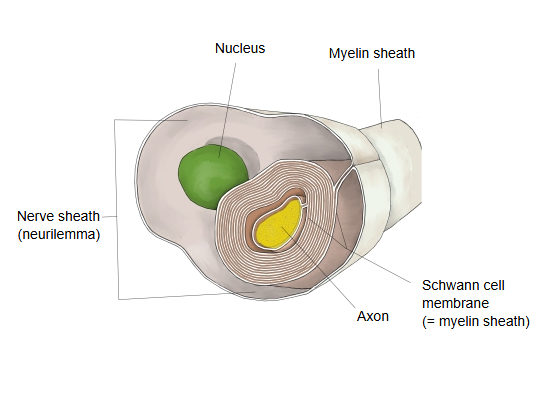
· One segment of myelin sheath is about 1–1.5 mm long; the short gaps between neighbouring Schwann cells are the nodes of Ranvier. Segment length varies with fibre size; sources differ.
· The nucleus, mitochondria and most of the cytoplasm lie in the outermost layer, the nerve sheath (neurilemma), which is covered by a basal lamina and the endoneurium.
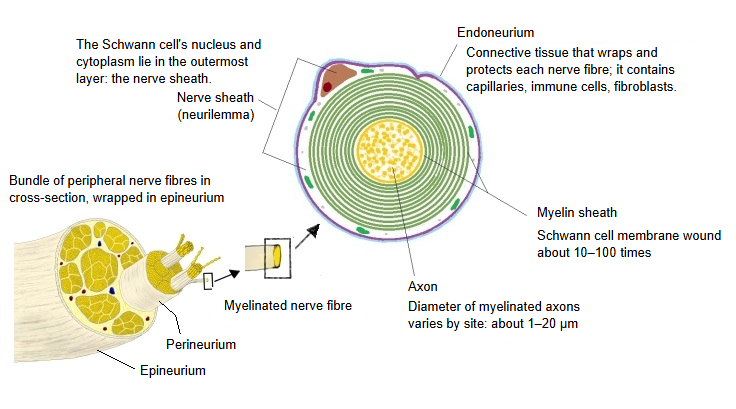
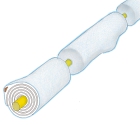 Myelinated nerve fibre
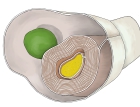 Myelin sheath made by a Schwann cell
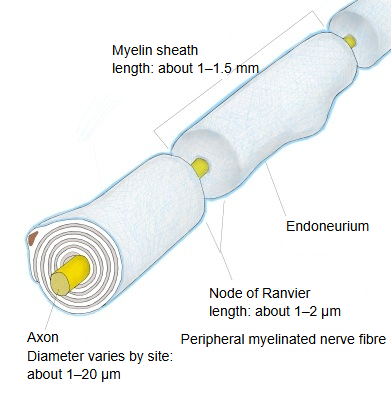
Further notes
Does a Schwann cell ever exist on its own, apart from an axon?
Normally it is always in contact with axons; it is found on its own only in disease or after injury.
Do Schwann cells divide actively?
In a healthy nerve they hardly divide. After injury they multiply, clear away debris and form tubes along which the axon can grow back.
Related terms
- Glial cell
- Myelinated nerve fibre
- Unmyelinated nerve fibre
- Node of Ranvier
- Axon
- Endoneurium
- Satellite cell
References and sources
- Further reading: Schwann cell, Wikipedia.
- Federative International Programme for Anatomical Terminology (FIPAT). Terminologia Anatomica, 2nd ed. (TA2), 2019.