Navicular articular surface (Latin: facies articularis navicularis tali)
The joint surface on the head of the talus that meets the posterior surface of the navicular.
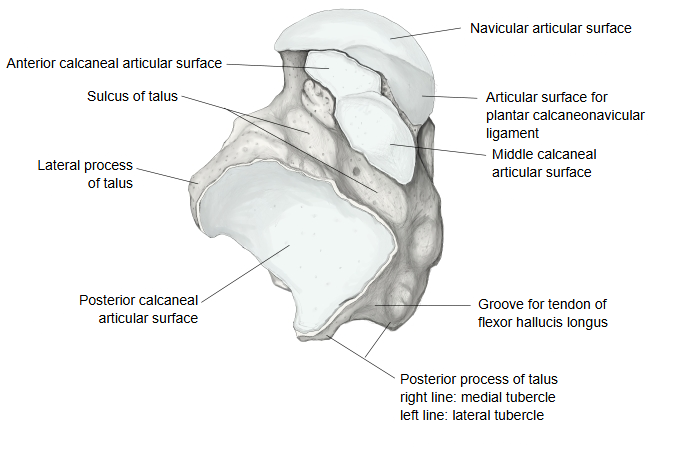
- Navicular articular surface : meets the posterior surface of the navicular.
- Articular surface for the calcaneonavicular ligament : rests on the plantar calcaneonavicular (spring) ligament, not on bone.
Anatomy texts describe it as follows.
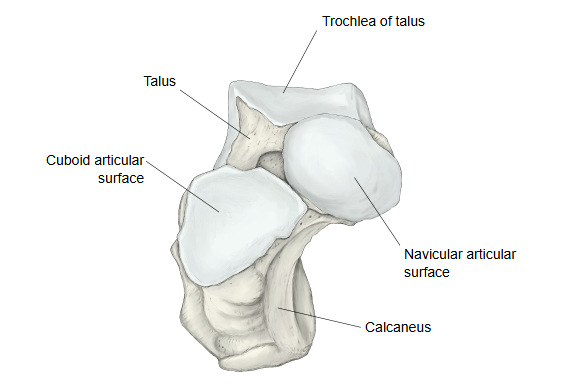
The head of the talus projects forwards, just in front of the neck, as a rounded part that is wider from side to side than from top to bottom. Its convex front is covered by the navicular articular surface, which fits into the concave posterior surface of the navicular at the talonavicular joint, part of the talocalcaneonavicular joint. On the medial and plantar side, a low ridge separates it from the articular surface for the calcaneonavicular ligament. That part does not touch the navicular; it rests on the plantar calcaneonavicular (spring) ligament. Further back on the underside of the head lie the anterior and middle calcaneal articular surfaces, which face the calcaneus.
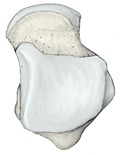 Right talus (superior view)
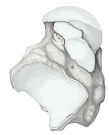 Right talus (inferior view)
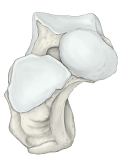 Right talus and calcaneus (anterior view)
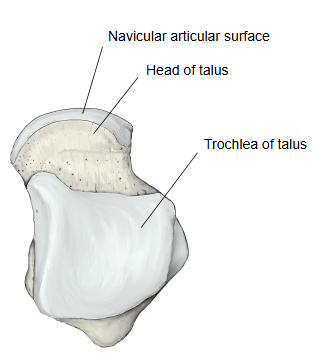
Where it is found
Related terms
- Head of talus
- Neck of talus
- Talonavicular joint
- Talocalcaneonavicular joint
- Anterior calcaneal articular surface
- Middle calcaneal articular surface
- Navicular
References and sources
- Further reading: Talus bone, Wikipedia.
- Further reading: Navicular bone, Wikipedia.
- Federative International Programme for Anatomical Terminology (FIPAT). Terminologia Anatomica, 2nd ed. (TA2), 2019.