Os trigonum (Latin: os trigonum)
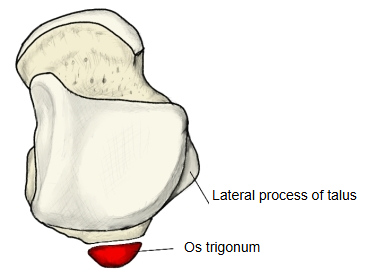
The lateral tubercle of the posterior process of the talus (or part of it) sometimes exists as a separate bone. It is then called the os trigonum: a small accessory bone behind the talus.
Anatomy textbooks describe it as follows.
The lateral tubercle of the posterior process (usually the larger of its two tubercles), or only part of it, sometimes stays separate from the body of the talus and forms an independent bone of the tarsus. The lateral tubercle has its own ossification centre, which normally fuses with the talus in adolescence; if it does not fuse, it remains as the os trigonum, joined to the talus by fibrous tissue or cartilage and often present on both sides. It has long been known. Reported frequencies vary widely between studies, from about 6% of adults in an older study to as much as a quarter in others; sources differ. It lies just lateral to the groove for the tendon of flexor hallucis longus and is best seen on a lateral radiograph of the ankle. In repeated forced plantar flexion (ballet, football) it can be pinched between the tibia and the calcaneus, causing pain at the back of the ankle (os trigonum syndrome).
Reference websites
[Wikipedia]
· Os trigonum, Wikipedia.
· Talus bone, Wikipedia.
[Websites with illustrations]
· Os trigonum on a lateral radiograph of the ankle (Wikimedia Commons)

· Talus: anatomy and clinical aspects (Kenhub)
Where it is found
Related terms
- Posterior process of talus
- Lateral tubercle of talus
- Medial tubercle of talus
- Groove for tendon of flexor hallucis longus
- Lateral process of talus
- Talus
References and sources
- Further reading: Os trigonum, Wikipedia.
- Further reading: Talus bone, Wikipedia.
- Federative International Programme for Anatomical Terminology (FIPAT). Terminologia Anatomica, 2nd ed. (TA2), 2019.