Osteoclast (Latin: osteoclastus)
cells
- Osteoblast : makes and secretes the bone matrix and so forms bone; it becomes an osteocyte when it is walled in by the matrix.
- Osteocyte : the most numerous cell in bone; osteocytes are linked to one another by fine processes.
- Osteoclast : breaks down bone.
From the bone marrow stem cell to the osteoclast
The osteoclast belongs to the macrophage family: it forms when several precursor cells of this line fuse.
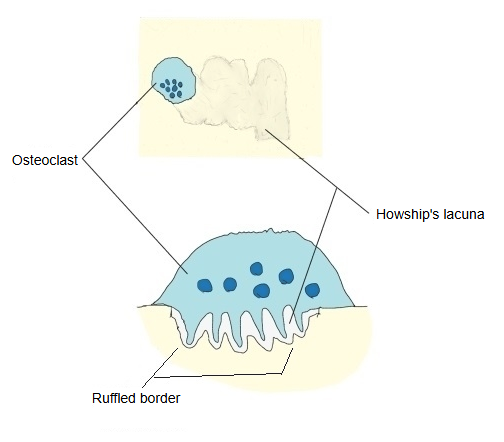
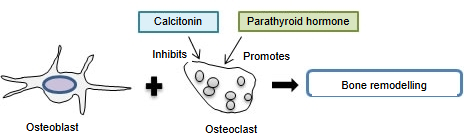
Where it is attached to the bone, the osteoclast's membrane is deeply folded into a ruffled border, which releases acid and enzymes that dissolve the mineral and digest the bone matrix; the shallow pit left behind is a Howship's lacuna (resorption bay). Osteoclasts form by fusion of precursor cells of the monocyte–macrophage lineage. Parathyroid hormone from the parathyroid glands increases osteoclast activity (mainly indirectly, through osteoblasts), which releases calcium into the blood, and calcitonin from the thyroid gland inhibits osteoclasts. Together with the osteoblasts that lay down new bone, osteoclasts carry out bone remodelling throughout life. See also bones by shape.
Reference websites
[Wikipedia]
· Osteoclast, Wikipedia.
· Bone remodeling, Wikipedia.
Related terms
References and sources
- Further reading: Osteoclast, Wikipedia.
- Further reading: Bone remodeling, Wikipedia.
- Federative International Programme for Anatomical Terminology (FIPAT). Terminologia Anatomica, 2nd ed. (TA2), 2019.