Pectoral girdle (Latin: cingulum pectorale)
Also called the shoulder girdle
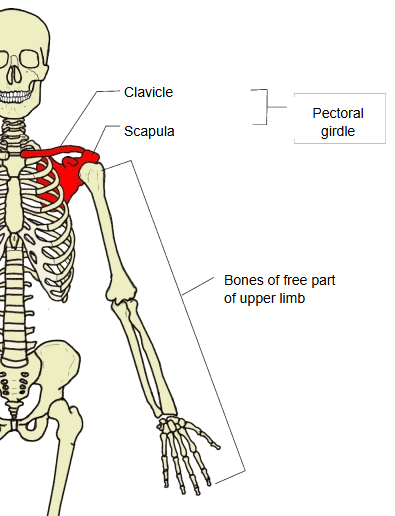
· Each side has one scapula and one clavicle; the bones of the free part of the upper limb begin with the humerus, and the pectoral girdle links them to the trunk.
· Its only joint with the axial skeleton is the sternoclavicular joint; the clavicle meets the scapula at the acromioclavicular joint.
· The scapula is held to the chest wall mainly by muscles, so the girdle is very mobile and greatly widens the range of movement of the arm.
· Unlike the pelvic girdle, it does not form a complete ring: the two scapulae do not meet behind.
Reference websites
[Wikipedia]
· Shoulder girdle, Wikipedia.
[Websites with illustrations]
· Shoulder girdle: anatomy, movements and function (Kenhub)
· The clavicle (TeachMeAnatomy)
· The scapula (TeachMeAnatomy)
· Left clavicle, superior surface (Gray's Anatomy, fig. 200) (Wikimedia Commons)

Related terms
- Scapula
- Clavicle
- Bones of upper limb
- Bones of free part of upper limb
- Sternoclavicular joint
- Acromioclavicular joint
- Pelvic girdle
References and sources
- Further reading: Shoulder girdle, Wikipedia.
- Federative International Programme for Anatomical Terminology (FIPAT). Terminologia Anatomica, 2nd ed. (TA2), 2019.