Periodontal membrane
Also called the periodontal ligament
The periodontal membrane is one of the tissues of the periodontium, the tissues that hold a tooth in place.
- Gingiva : the part of the oral mucosa that surrounds the teeth, the 'gums'. Includes the attached gingiva, the interdental papillae and the free gingiva.
- Periodontal membrane : the fibrous connective tissue, with vessels and nerves, between the root and the alveolar bone; also called the periodontal ligament.
- Cementum : one of the dental tissues: a thin bone-like layer covering the root. Two kinds: acellular cementum and cellular cementum.
- Alveolar bone : the bone that holds the roots: the alveolar bone proper lining the socket and the supporting alveolar bone around it.
The list above follows Wikipedia. Cementum is one of the dental tissues (part of the tooth itself), yet it is counted as part of the periodontium because the fibres that hold the tooth are anchored in it.
Direction of Sharpey's fibres (after a Japanese anatomy textbook)
Origin: the fibre bundles of the Sharpey's fibres arise within the cementum.
Upper part of the root: they fan out upward, especially toward the papillae of the gingiva, and below that they run horizontally.
Middle to lower part of the root: they run upward (obliquely from the cementum to the bone).
Apex of the root: they run downward.
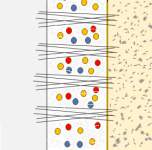 Periodontal ligament (diagram)
 Cementum and periodontal ligament (microscopic)
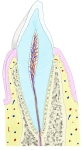 Tooth in its socket (section)
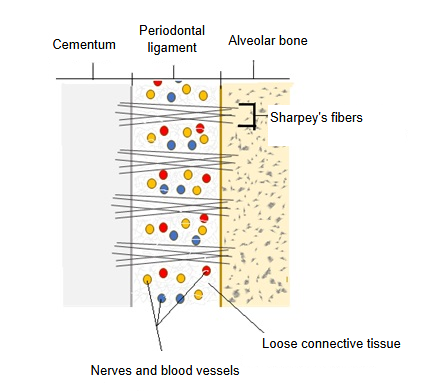
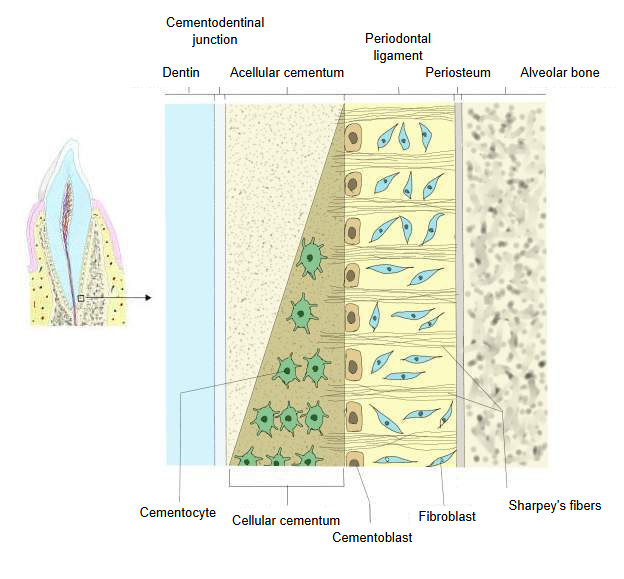
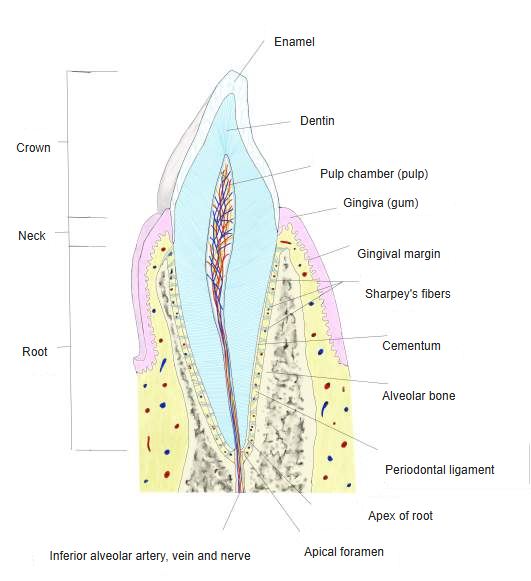
The periodontal membrane fills the space between the bone of the tooth socket and the root. It is poor in elastic fibres but rich in Sharpey's fibres made of collagen fibre bundles, and many nerve fibres pass through it. At the mouth of the socket its fibres join the neck of the tooth to the rim of the socket as a strong ring. The fibres anchor the tooth firmly and work as an elastic cushion against the pressure of biting, and its nerves sense the force of biting.
Reference websites
[Wikipedia]
· Periodontal ligament, Wikipedia.
· Periodontium, Wikipedia.
[Websites with illustrations]
· Periodontium (diagram) (Wikimedia Commons)

· Periodontal ligament (Dental Image Library)

· Periodontal ligament (figure) (Periodontology 2000 (Wiley))
