Posterior border of radius (Latin: margo posterior radii)
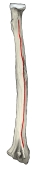 Right radius (posterior)
 Right radius (posterior)
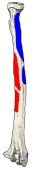 Muscle attachments (posterior)
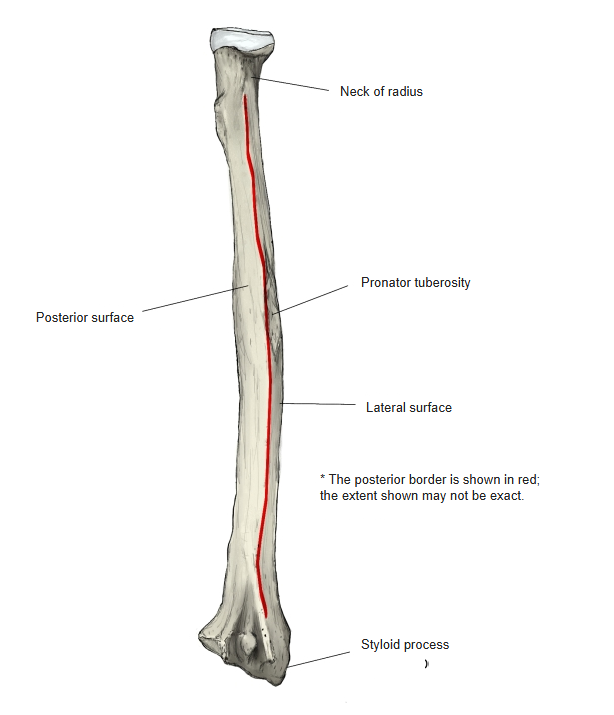
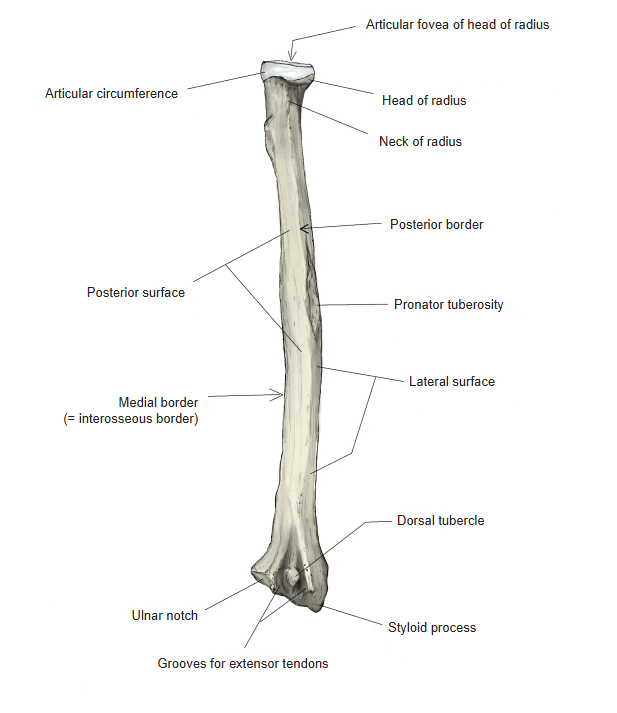
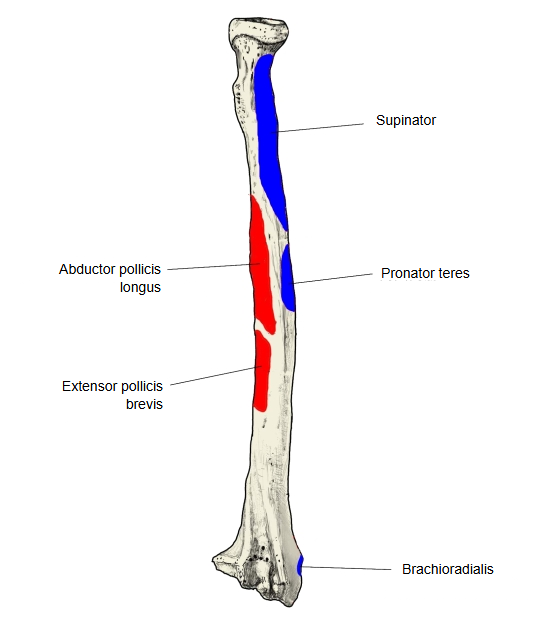
The posterior border runs down the back of the radius from the back of the neck to the back of the base of the styloid process. It is faint in its upper and lower parts and well marked only in the middle third of the shaft. Medial to it, the posterior surface gives origin to abductor pollicis longus and extensor pollicis brevis; lateral to it, the lateral surface carries the insertions of supinator and pronator teres. The other two borders are the anterior border and the interosseous border.
· Human anatomy video: The Radius (the borders and surfaces are shown from about 4:10)
Reference websites
[Wikipedia]
· Radius (bone), Wikipedia.
[Websites with illustrations]
· Right radius, upper end (posterior view) (Wikimedia Commons)

· Bones of the left forearm, posterior surface (Gray's Anatomy, fig. 214) (Wikimedia Commons)

· The radius (TeachMeAnatomy)
Where it is found
Related terms
- Anterior border of radius
- Interosseous border of radius
- Posterior surface of radius
- Lateral surface of radius
- Body of radius
- Styloid process of radius
- Neck of radius
References and sources
- Further reading: Radius (bone), Wikipedia.
- Federative International Programme for Anatomical Terminology (FIPAT). Terminologia Anatomica, 2nd ed. (TA2), 2019.