Radial tuberosity (Latin: tuberositas radii)
Also called the bicipital tuberosity
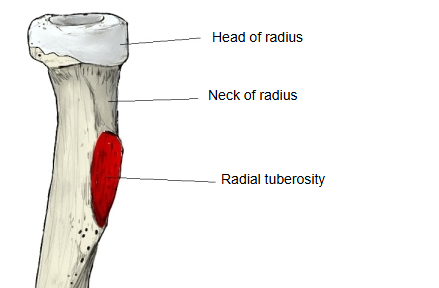
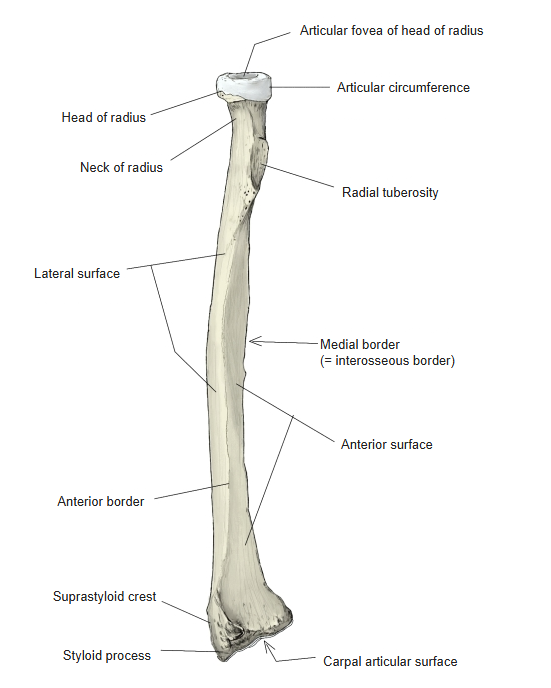
The oval bony prominence on the front of the medial side of the upper part of the radius, just below the neck and the head of the radius.
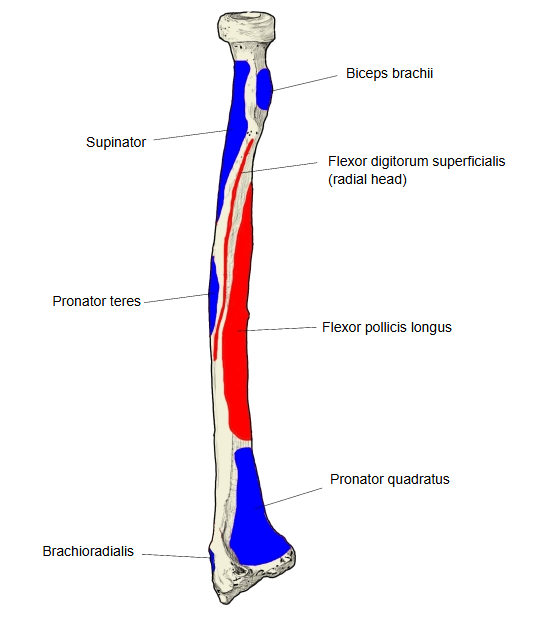
· It is the insertion of biceps brachii.
· Its surface is divided into two parts, a rough part and a smooth part.
· It is the insertion of biceps brachii.
· Its surface is divided into two parts, a rough part and a smooth part.
At the upper end of the front of the body of the radius, about 2 cm below the head, the radial tuberosity rises as an oval prominence facing forwards and medially, at the junction of the neck and the body; the tendon of biceps brachii is attached to it. Through it biceps flexes the elbow and is the strongest supinator of the forearm; in pronation the tuberosity turns backwards and the tendon wraps round the radius. Rupture of the distal biceps tendon usually means the tendon has torn away from this tuberosity.
Radial
tuberosity
tuberosity
- Rough part (posterior) : insertion of the tendon of biceps brachii.
- Smooth part (anterior) : a bursa (the bicipitoradial bursa) lies between the biceps tendon and the bone, so that the tendon can glide over it. Older texts (and Gray's Anatomy) give the reverse: rough insertion in front, bursa behind.
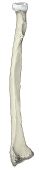 Right radius (anterior)
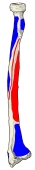 Muscle attachments (anterior)
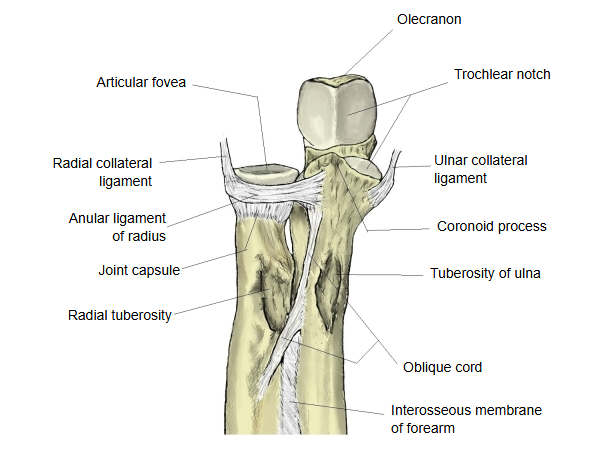
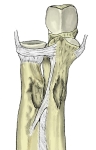 Right elbow ligaments (anterior)
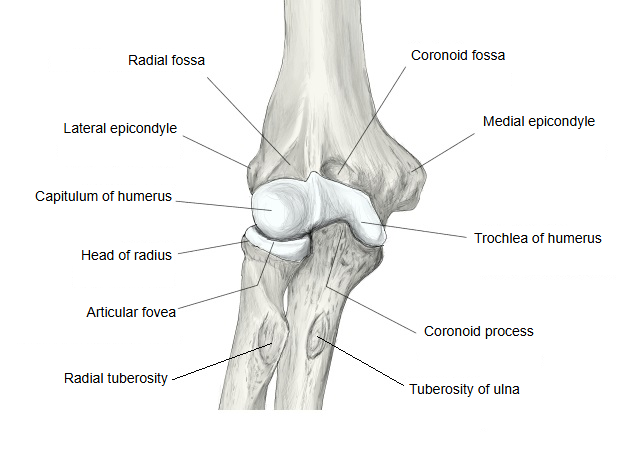
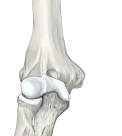 Right elbow joint (anterior)
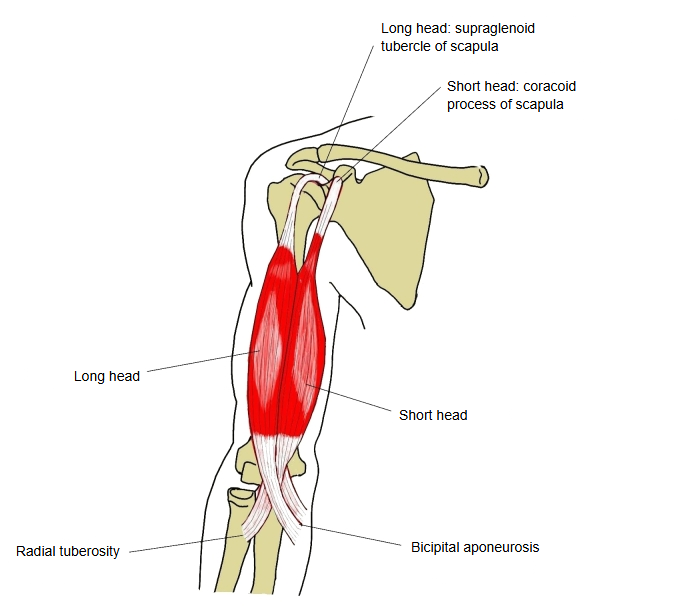
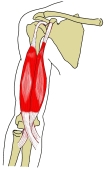 Right biceps brachii
· Video: The radius (the radial tuberosity is explained from about 3:00).
Where it is found
Related terms
- Neck of radius
- Head of radius
- Body of radius
- Pronator tuberosity
- Proximal epiphysis of radius
- Radius
References and sources
- Further reading: Radial tuberosity, Wikipedia.
- Further reading: Biceps, Wikipedia.
- Federative International Programme for Anatomical Terminology (FIPAT). Terminologia Anatomica, 2nd ed. (TA2), 2019.