Endoplasmic reticulum (Latin: reticulum endoplasmicum)
Also called ER
One of the structures inside each cell of the body (the organelles); the ribosomes on its rough part make the proteins that are secreted or built into membranes (other proteins are made on free ribosomes in the cytosol).
of the
cell
- Cell membrane : phospholipid bilayer, membrane proteins, sugar chains
- Cytoplasm
- Cytosol : water, electrolytes, metabolic enzymes, free amino acids, metabolic intermediates
- Organelles : mitochondria, endoplasmic reticulum, centrosome, Golgi apparatus, lysosomes, peroxisomes, vesicles (some sources do not count vesicles as organelles)
- Cytoskeleton : microtubules, actin filaments, intermediate filaments
- Nucleus : nuclear envelope, nucleoplasm, chromatin, nucleolus; the nucleus is also counted among the organelles
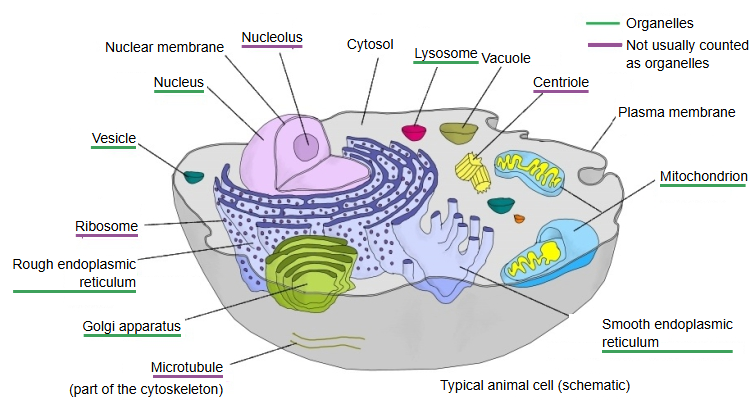
In more detail
The endoplasmic reticulum (ER) is a system of flattened sacs and branching tubes enclosed by a membrane; its membrane is continuous with the outer membrane of the nuclear envelope, and its inner space forms one connected compartment. By its shape it is divided into the two forms below, which are connected with each other.
| 1 | Rough endoplasmic reticulum | Stacks of flattened sacs (cisternae) with many ribosomes attached to their outer surface, which give it its rough look and its name. It is plentiful in cells that make much protein for export, such as gland cells (glandular cells) and plasma cells. | 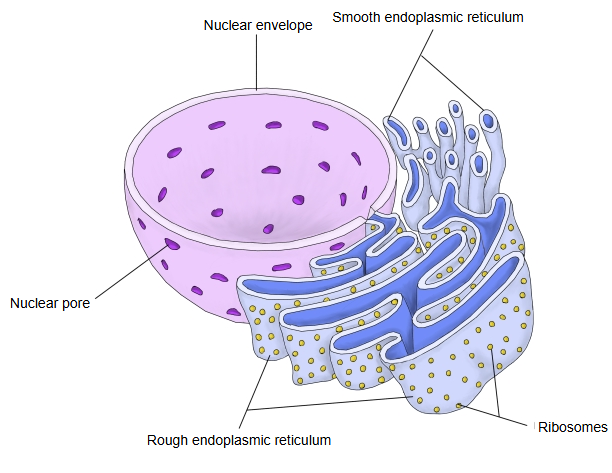 |
| 2 | Smooth endoplasmic reticulum | Branching tubules with no ribosomes attached. It is plentiful in cells that make steroid hormones and in liver cells. In skeletal muscle fibres the smooth ER stores calcium ions and is called the sarcoplasmic reticulum (SR); the calcium it releases triggers contraction. |
The functions of the endoplasmic reticulum include the following.
| 1 | Synthesis and transport of proteins |
| A function of the rough ER. Proteins made by the ribosomes pass through a channel in the membrane, the translocon, into the lumen of the ER, where they fold into their finished three-dimensional shape and are modified (secretory proteins and membrane proteins). Transport vesicles budding from the ER then carry them on, mostly by way of the Golgi apparatus, to other organelles or to the cell membrane. Proteins that fail to fold correctly are sent back out through the translocon and broken down. |
Synthesis and transport of proteins
| 2 | Synthesis of phospholipids, steroids and fatty acids |
| The smooth ER makes phospholipids, steroids, fatty acids and other lipids. | |
| 3 | Storage of calcium |
| The endoplasmic reticulum is a store of calcium ions; together with calcium entering from outside the cell, it controls the calcium concentration inside the cell. | |
| 4 | Metabolism of many substances |
| Its enzymes, such as the cytochromes including cytochrome P450, metabolise many substances; in liver cells they break down drugs and other foreign substances. |
The two forms of the endoplasmic reticulum and their work
Other functions: storage of calcium; metabolism of many substances by enzymes.
Reference websites
[Wikipedia]
· Endoplasmic reticulum, Wikipedia.
· Sarcoplasmic reticulum, Wikipedia.
· Translocon, Wikipedia.
[Websites with illustrations]
· Endoplasmic reticulum (images and electron micrographs) (Wikimedia Commons)
· Rough endoplasmic reticulum (images) (Wikimedia Commons)
Related terms
- Golgi apparatus
- Cytoplasm
- Ribosome
- Organelle
- Nuclear envelope
- Cell nucleus
- Vesicle
- Nucleolus
- Glandular cell
- Skeletal muscle
References and sources
- Further reading: Endoplasmic reticulum, Wikipedia.
- Federative International Programme for Anatomical Terminology (FIPAT). Terminologia Anatomica, 2nd ed. (TA2), 2019.