Self-renewal
Definition
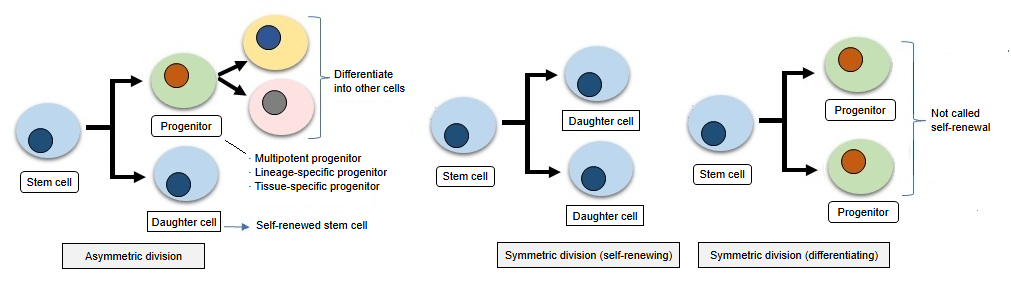
· When a stem cell divides into two cells, one of them can keep the same properties as the parent cell (it stays a stem cell).
· The other goes on to differentiate, usually through a progenitor cell, into cells with particular functions.
In this way the body can keep its pool of stem cells while supplying the cells it needs.
Features
a. Asymmetric and symmetric division: in asymmetric division one daughter stays a stem cell and the other differentiates; in symmetric self-renewing division both daughters stay stem cells.
b. Keeping tissues in balance: self-renewal keeps up the supply of cells in tissues whose cells are constantly replaced, such as the skin, the blood, the lining of the intestine and bone.
c. Long-term maintenance: adult (somatic) stem cells can usually renew themselves throughout life.
Examples
| Stem cell | Why self-renewal matters | |
|---|---|---|
| 1 | Hematopoietic stem cell (HSC) | Supplies blood cells throughout life while keeping a pool of HSCs. |
| 2 | Mesenchymal stem cell (MSC) | Supplies bone cells, cartilage cells and fat cells while keeping a pool of MSCs. |
| 3 | Neural stem cell | Replaces neurons and glial cells while keeping a pool of neural stem cells. |
Summary
· Self-renewal is the ability of a stem cell to copy itself and so keep the stem-cell pool.
· Because of it, tissues can go on making new cells for a long time.
· Not all cells can renew themselves; the ability belongs to stem cells.
Related terms
References and sources
- Further reading: Stem cell, Wikipedia.
- Federative International Programme for Anatomical Terminology (FIPAT). Terminologia Anatomica, 2nd ed. (TA2), 2019.