Simple bony limb (Latin: crus osseum simplex)
Also called the simple crus or (bony) simple limb
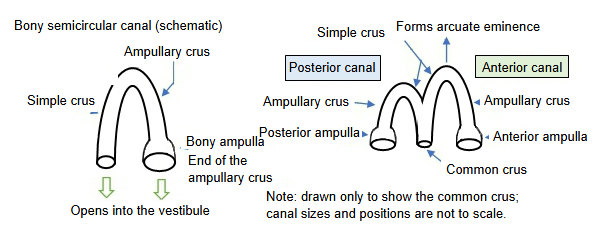
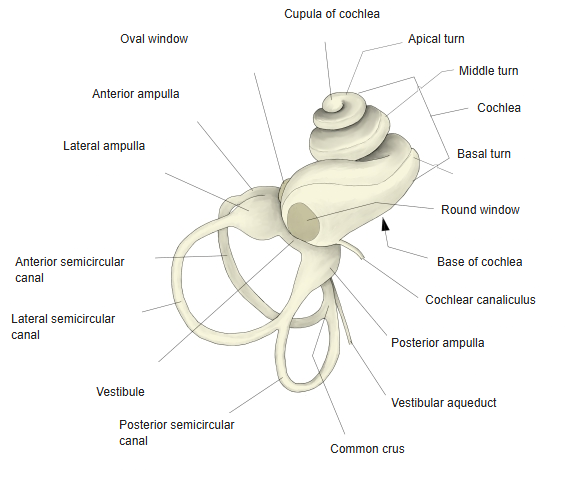
The (bony) simple crus is one of the two crura of a bony semicircular canal; where it opens into the vestibule, it is about the same width as the rest of the canal.
Two crura: the (bony) simple crus and the (bony) ampullary crus, which swells into a bony ampullaBony semicircular canals: three C-shaped tubes that form the back part of the bony labyrinth of the inner ear (semicircular canals)
The simple crura of the anterior (bony) semicircular canal and the posterior (bony) semicircular canal join to form the (bony) common crus, so they open into the vestibule by a single opening.
- Anterior canal
- Simple crus : joins the simple crus of the posterior canal; as the (bony) common crus it opens into the medial wall of the back part of the vestibule.
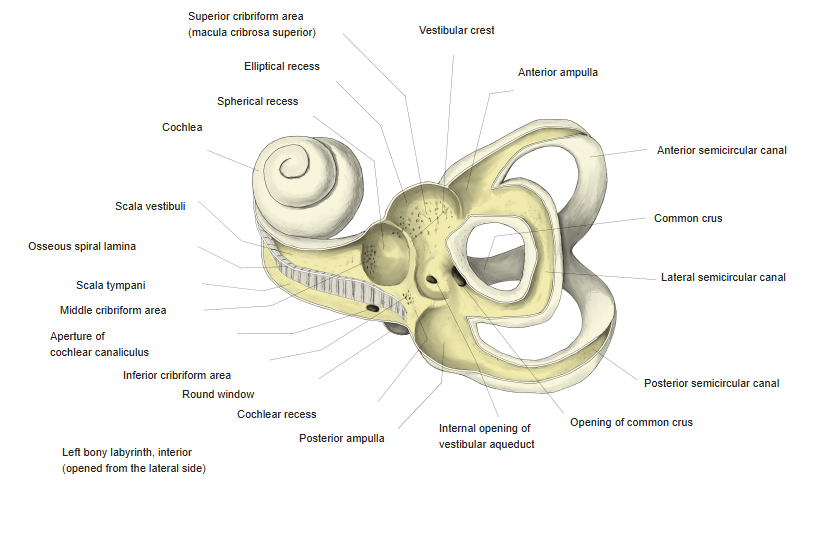
- Ampullary crus → anterior bony ampulla : opens into the upper part of the vestibule, near the elliptical recess.
- Lateral canal
- Ampullary crus → lateral bony ampulla : opens into the vestibule just below the anterior ampulla, lateral to the elliptical recess.
- Simple crus : opens on its own into the back of the vestibule, between the common crus and the posterior ampulla.
- Posterior canal
- Simple crus : joins the simple crus of the anterior canal to form the (bony) common crus.
- Ampullary crus → posterior bony ampulla : opens into the lower back part of the vestibule.
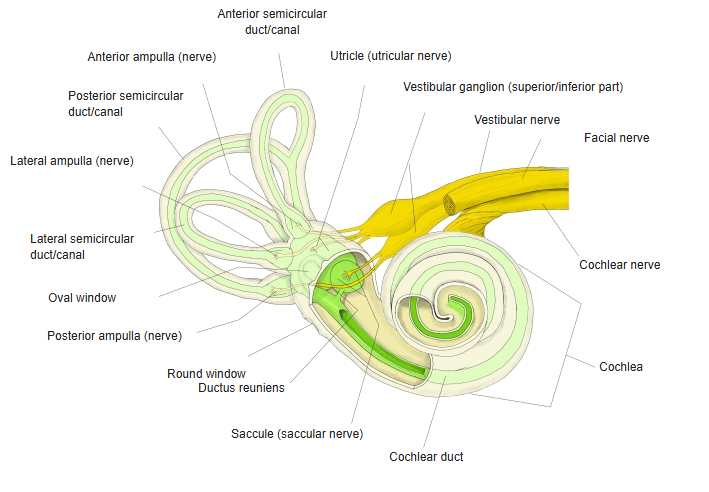
Each of the three bony semicircular canals has two limbs: an ampullary limb, which swells into the bony ampulla, and a simple limb. Because the simple limbs of the anterior and posterior canals join into the common crus, while the simple limb of the lateral canal opens on its own, the three canals open into the vestibule by five openings: three ampullae, the common crus and the lateral simple crus. The simple crus contains the simple membranous limb of the corresponding semicircular duct, surrounded by perilymph.
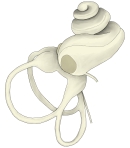 Bony labyrinth
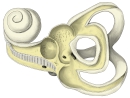 Bony labyrinth (opened)
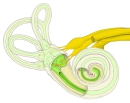 Labyrinth and nerves
Related terms
- Anterior semicircular canal
- Posterior semicircular canal
- Lateral semicircular canal
- Bony ampullae
- Semicircular canals
- Bony labyrinth
- Vestibule
References and sources
- Further reading: Semicircular canals, Wikipedia.
- Further reading: Bony labyrinth, Wikipedia.
- Federative International Programme for Anatomical Terminology (FIPAT). Terminologia Anatomica, 2nd ed. (TA2), 2019.