Stratum spinosum (Latin: stratum spinosum epidermidis)
Also called the spinous layer or prickle cell layer
of the
epidermis
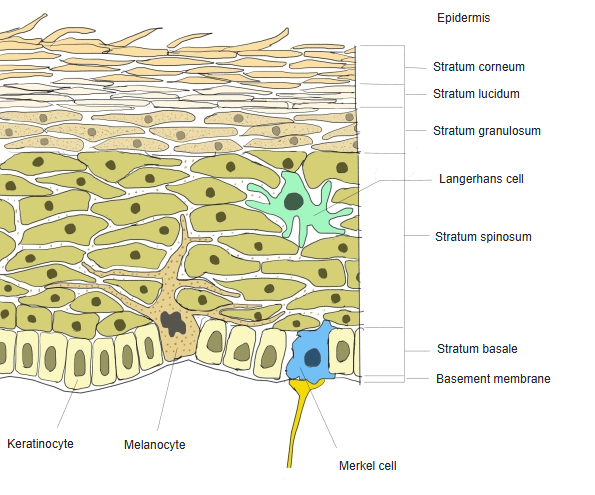
- Stratum corneum : the outermost layer, made of dead keratinocytes; the surface is constantly shed (desquamation).
- Stratum lucidum : a clear, bright layer at the bottom of the stratum corneum, seen only in thick skin (fingertips, palms, soles); its cells have no nuclei.
- Stratum granulosum : 2–3 rows of many-sided cells with keratohyalin granules in their cytoplasm; the nuclei begin to break down.
- Stratum spinosum : stacked rows of many-sided keratinocytes; the thickest layer; the cells are joined by intercellular bridges.
- Stratum basale : a single layer of columnar basal cells (keratinocytes); also melanocytes and Merkel cells.
· It makes up most of the epidermis and has several rows of cells; numbers such as 3 to 8 rows are quoted (sources differ), and it is thicker in thick skin.
· Its cells stain well with basic dyes such as hematoxylin.
· The stratum basale and the stratum spinosum together are called the Malpighian layer, the living, dividing part of the epidermis (see also germinal layer).
· The nucleus is large, round and pale, with little chromatin.
· In ordinary sections the cells shrink apart but stay attached at the desmosomes, so they look covered in short spines; this gives the layer its name. The cells are busy making keratin filaments, which gather into bundles (tonofibrils) anchored at the desmosomes; lamellar bodies first appear here.
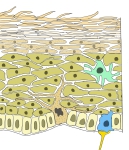 Layers of the epidermis
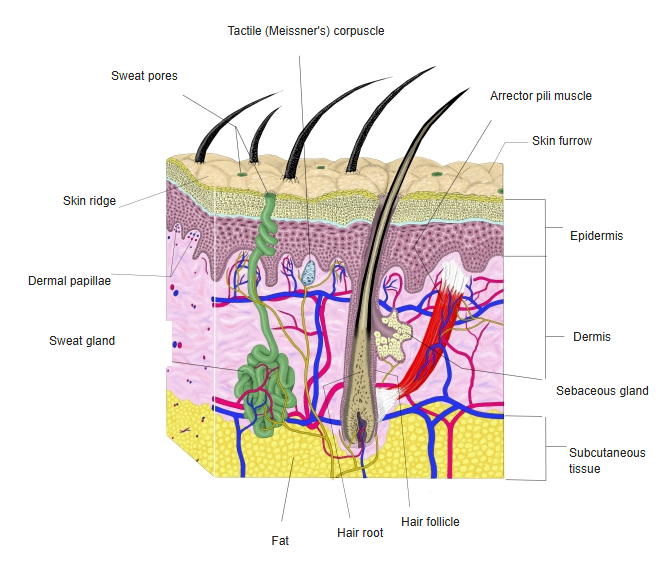
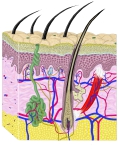 Structure of the skin
Reference websites
[Wikipedia]
· Stratum spinosum, Wikipedia.
· Epidermis, Wikipedia.
Related terms
References and sources
- Further reading: Stratum spinosum, Wikipedia.
- Further reading: Epidermis, Wikipedia.
- Federative International Programme for Anatomical Terminology (FIPAT). Terminologia Anatomica, 2nd ed. (TA2), 2019.