Subcutaneous tissue (Latin: Tela subcutanea)
Also called: hypodermis; subcutis; tela subcutanea
- Epidermis : stratified squamous epithelium; from the outside: stratum corneum, stratum lucidum, stratum granulosum, stratum spinosum, stratum basale
- Dermis : densely arranged collagen fibres and elastic fibres; divided into a papillary layer and a reticular layer, with no sharp boundary between them
- Subcutaneous tissue : loose connective tissue with many fat cells; contains parts of sweat glands and nerve endings. Sometimes not counted as part of the skin.
· In most places the boundary between the dermis and the subcutaneous tissue is not sharp.
· Where the skin proper is taken to be only the epidermis and dermis, the subcutaneous tissue is not part of it; either way, in function it works together with the skin.
· It is also called the superficial fascia (subcutaneous fascia) and separates the muscles from the skin. In general it joins the skin to the deep fascia and the periosteum of the body.
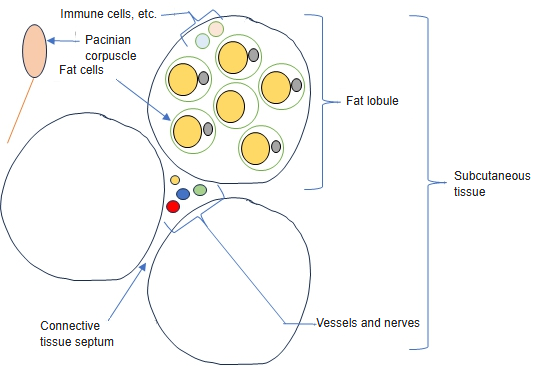
· Each fat lobule is separated from the next by septa of connective tissue, which carry networks of blood vessels, lymphatic vessels and nerves.
· It also contains the nerve endings called Pacinian (lamellar) corpuscles, which sense pressure and vibration.
· Besides fat cells filled with lipid droplets, the adipose tissue contains many other kinds of cells, such as immune cells, in its stroma.
· Here and there, bundles of fibres arise from the dermis, pass through the subcutaneous fat and attach firmly to the fascia or periosteum (skin ligaments), anchoring the skin.
· As special structures, in the scrotum, penis, labia majora and nipple, the subcutaneous tissue has little fat but many smooth muscle fibres; this smooth muscle layer is called the dartos (tunica dartos).
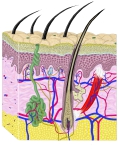 Skin
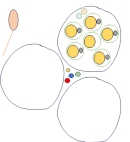 Subcutaneous tissue (schematic)
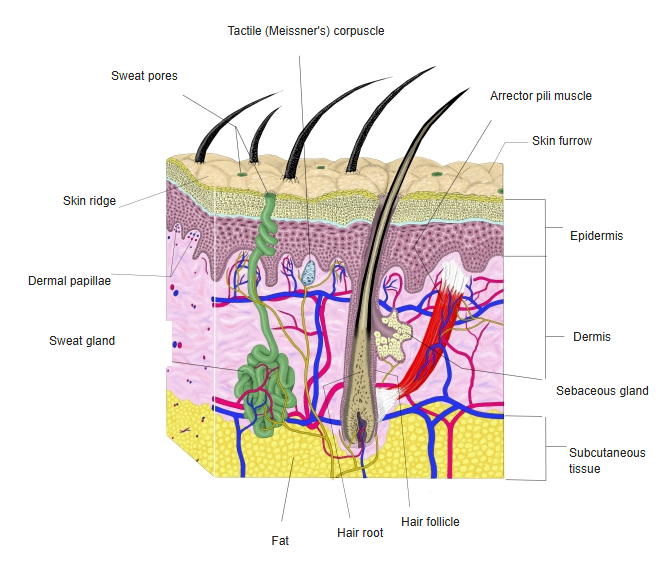
Other facts: the subcutaneous tissue (hypodermis, subcutis) is the deepest layer of the integument. It consists mainly of loose connective tissue and fat, with fibroblasts, fat cells and macrophages, and is derived from mesoderm. It is attached to the dermis by collagen and elastic fibres and anchored to the deep fascia by fibrous bands. It contains larger blood vessels and nerves than the dermis (vessels on their way to the dermis, lymphatic vessels coming from it), cutaneous nerves, the roots of hair follicles, the secretory parts of some sweat glands, Ruffini and Pacinian corpuscles, mast cells, and in places bursae over joints that let the skin glide. The mammary glands lie entirely within it. Fat is absent from the eyelids, the penis and scrotum, the clitoris and most of the auricle. The subcutaneous fat acts as padding, an energy store and insulation; it lies just under the skin, unlike visceral fat inside the abdominal cavity, and its thickness can be measured with skinfold calipers to estimate body fat.
See also: Hypodermis (subcutaneous tissue)
Reference websites
[Wikipedia]
· Subcutaneous tissue, Wikipedia.
[Websites with illustrations]
· Layers of the skin (Wikimedia Commons)

· Structure of the skin (Wikimedia Commons)
