Muscle fascicle
Also called: muscle bundle; fasciculus
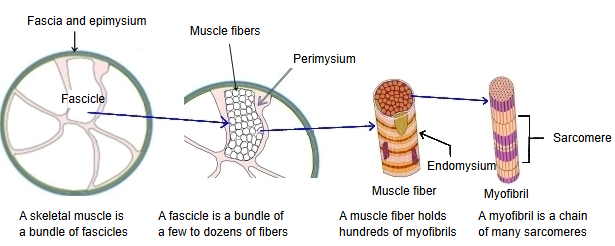
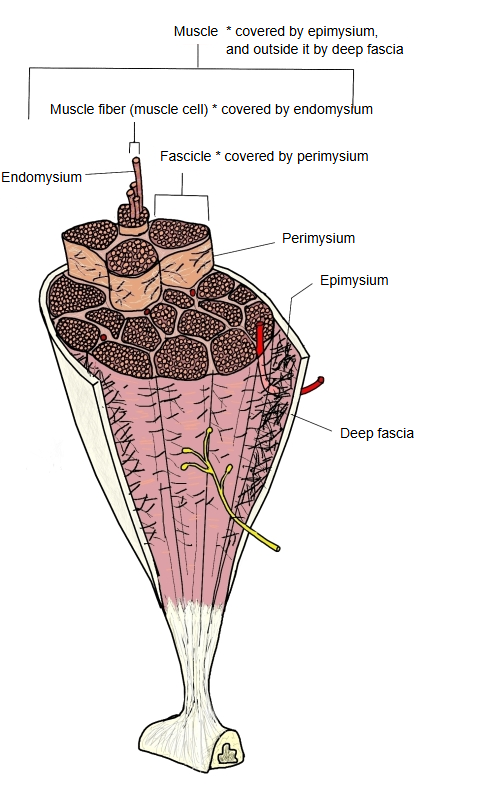
The main parts of a muscle, from the smallest to the largest, are:
Each arrow means: many of these gather to form the next.
Muscles used for fine control tend to have small fascicles; large postural muscles have large ones. Blood vessels and nerves run in the perimysium between the fascicles before branching to the fibres. The way the fascicles are arranged (parallel, fusiform, pennate, convergent or circular) sets the shape of a muscle, how far it can shorten and how much force it can produce. Outside the epimysium lies the deep fascia; at the ends of the muscle the connective tissue continues into the tendon. See also the list of skeletal muscles.
Reference websites
[Wikipedia]
· Muscle fascicle, Wikipedia.
[Websites with illustrations]
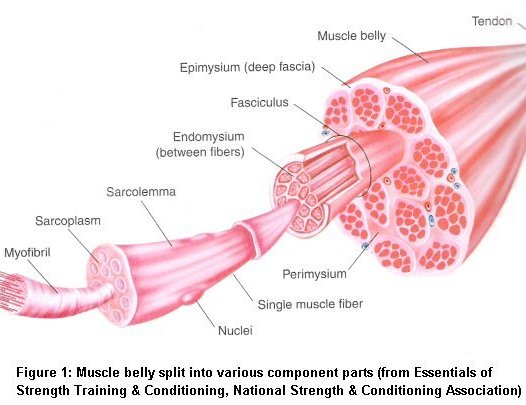
· Muscle belly split into its parts: fasciculus, perimysium, endomysium, muscle fibre (sport-fitness-advisor.com)
· From muscle to bundle of muscle fibres, muscle fibre, myofibril and sarcomere (nicerweb.com)

· Structure of skeletal muscle (Wikimedia Commons)

Related terms
References and sources
- Further reading: Muscle fascicle, Wikipedia.
- Federative International Programme for Anatomical Terminology (FIPAT). Terminologia Anatomica, 2nd ed. (TA2), 2019.