Trabecula (Latin: trabecula)
Plural: trabeculae; literally "little beam"
Overview
· Main components of the capsule and the trabeculae: collagen fibres, reticular fibres (reticulin fibres) and fibroblasts.
Difference: the connective tissue of the trabeculae is somewhat looser than that of the capsule.
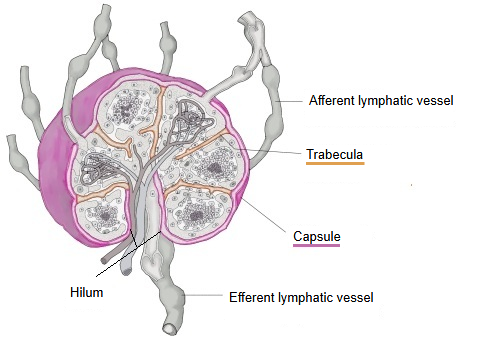
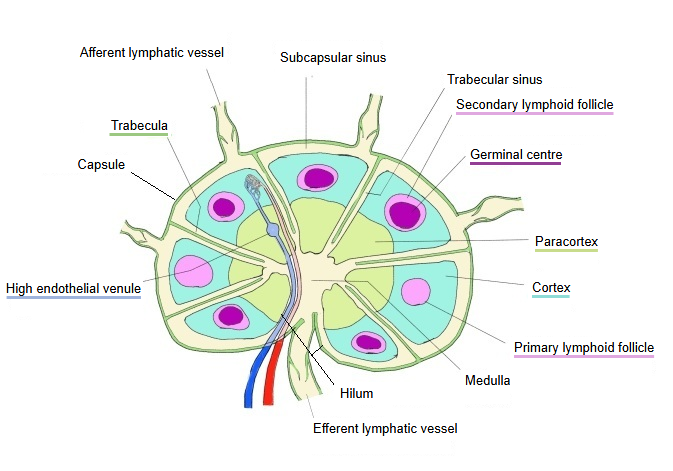
In a lymph node the trabeculae grow inward from the capsule towards the hilum and divide the cortex into incomplete compartments. Blood vessels and nerves run along them, and lymph flows beside them in the trabecular sinuses, between the subcapsular sinus and the medullary sinuses.
Trabeculae in other organs
Q: Are there structures called trabeculae in organs other than the lymph node?
A: Structures called trabeculae are not limited to the lymph node, although the term is used with particular emphasis there.
Main organs other than the lymph node where structures called trabeculae are found:
1. 1. Spleen
· Very important and often met.
· Connective-tissue strands that run from the splenic capsule into the organ.
· They support the white pulp.
· They form the framework that supports the red pulp.
· Blood vessels (branches of the splenic artery and vein) run in them.
→ The lymph node and the spleen are often learnt together.
2. 2. Corpora cavernosa (penis and clitoris)
· Trabeculae of the corpora cavernosa.
· Smooth muscle + connective tissue.
· Column-like structures that separate the blood-filled cavernous spaces.
A term often met in histology.
3. 3. Heart (limited use)
· Trabeculae carneae: the muscular ridges on the inner wall of the ventricles.
· The name means "fleshy little beams".
· The word comes from the same Latin trabecula (little beam).
→ They are muscle, not connective tissue, but in English the name has the same root.
4. 4. Bone (a different concept)
· Bone trabeculae (trabeculae).
· The beam-like plates and rods of spongy (cancellous) bone.
· These are bone tissue, not connective-tissue strands, so they are usually named separately as bone trabeculae.
Examples: in the liver, kidney, lung and others, other terms are used instead, such as septa, interstitium or cords.
Summary table
| Organ | Use of the term | Remarks | |
|---|---|---|---|
| 1 | Lymph node | Yes | Typical example |
| 2 | Spleen | Yes | Often met |
| 3 | Corpora cavernosa | Yes | Trabeculae of the corpora cavernosa |
| 4 | Heart | Partly | As trabeculae carneae (muscle) |
| 5 | Bone | Partly | Bone trabeculae, a different concept |
Related terms
References and sources
- Further reading: Trabecula, Wikipedia.
- Further reading: Lymph node, Wikipedia.
- Federative International Programme for Anatomical Terminology (FIPAT). Terminologia Anatomica, 2nd ed. (TA2), 2019.