Capsule (Latin: capsula)
Also called the organ capsule or fibrous capsule
Overview
· The connective tissue of a capsule is mainly dense irregular connective tissue (collagen fibres); some capsules also contain elastic fibres or smooth muscle. Partitions (septa or trabeculae) often run inward from it, divide the organ into lobes or lobules and carry vessels and nerves.
Example: the kidney is a solid organ wrapped entirely in its fibrous capsule, and on its retroperitoneal side it is also embedded in an adventitia (fat and loose connective tissue).
around organs
and tubes
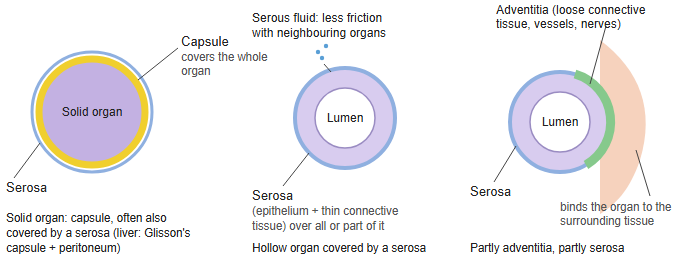
- Serosa : structure: a simple squamous epithelium (mesothelium) on a thin layer of connective tissue; secretes serous fluid that reduces friction. It covers organs that face a body cavity: the pleura, pericardium and peritoneum (each organ's part has its own name), e.g. the small and large intestines (in part).
- Adventitia : structure: loose connective tissue with vessels and nerves; anchors the organ to the surrounding tissue, with no clear boundary. E.g. oesophagus, duodenum, parts of the large intestine, large blood vessels, trachea and bronchi.
- Capsule : the outer layer that is part of a solid organ, so not the same as an "organ + membrane" arrangement; it can be covered further by a serosa or an adventitia.
- Not covered by these
- Open to the outside : oral cavity, nasal cavity, pharynx, larynx, external acoustic meatus, anal canal.
- Central nervous system : brain and spinal cord: covered by the meninges.
- Others : bone: periosteum; muscle: fascia; skin: epidermis and dermis.
Capsule: a membrane (dense connective tissue) that is part of a solid organ; it may be covered further by a serosa or an adventitia.
Serosa: "epithelium + connective tissue"; covers organs facing a body cavity and secretes serous fluid that reduces friction.
Adventitia: "loose connective tissue + vessels and nerves"; anchors the organ to the surrounding tissue.
List of organs
| Organ | Other covering | Notes | |
|---|---|---|---|
| 1 | Liver | Serosa (peritoneum) | Contains a few elastic fibres. Wraps the liver tissue; vessels and bile ducts run in its extensions into the organ. |
| 2 | Kidney | Adventitia | Wraps the renal parenchyma; surrounded by the perirenal fat. |
| 3 | Spleen | Serosa (peritoneum) | Contains smooth muscle fibres; wraps the splenic tissue and sends trabeculae inward. |
| 4 | Suprarenal gland | - | Separates the gland tissue from the surrounding fat. |
| 5 | Ovary | Surface epithelium (modified serosa) | Dense capsule (tunica albuginea) around the ovarian tissue. |
| 6 | Testis | Serosa (tunica vaginalis) | Dense capsule (tunica albuginea) with a little smooth muscle; septa from it divide the testis into lobules containing the seminiferous tubules. |
| 7 | Thymus | None | Wraps the thymus; septa from it divide it into lobules. |
| 8 | Thyroid gland | None | Septa run from the capsule into the gland and divide it into lobules. |
| 9 | Pancreas | None | A thin capsule around the gland; bundles of vessels and nerves pass through its septa. |
Related terms
References and sources
- Further reading: Capsule (anatomy), Wikipedia.
- Further reading: Connective tissue, Wikipedia.
- Federative International Programme for Anatomical Terminology (FIPAT). Terminologia Anatomica, 2nd ed. (TA2), 2019.