Trachealis (Latin: musculus trachealis)
Also called the trachealis muscle
The trachealis (trachealis muscle) is the layer of smooth muscle in the back of the trachea, in its membranous wall; it is made of an inner layer of transverse (circular) fibres and a thin outer layer of longitudinal fibres.
Smooth muscle: involuntary muscleTrachea: one of the airways of the respiratory tractMembranous wall: the back part of the trachea, where there is no cartilageThe transverse fibres, which join the open ends of the cartilages, form the main part; the outer longitudinal fibres are sparse, and many sources describe only the transverse layer
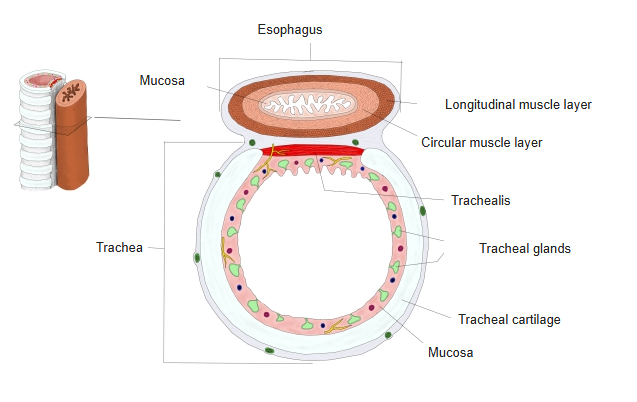
· It lies in the membranous wall between the trachea and the esophagus, bridging the open back ends of the C-shaped tracheal cartilages.
· When it contracts it narrows the trachea, which raises the speed of the air flow, for example in coughing. It is the only muscle in the wall of the trachea.
Structure
of the
trachea
of the
trachea
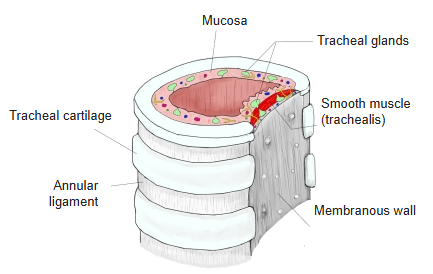
- Tracheal cartilages : 15–20 C-shaped bars of hyaline cartilage, each about 3–4 mm wide.
- Annular ligaments : continuations of the connective tissue membrane (fibroelastic membrane) that wraps the whole set of cartilages.
- Mucosa : well developed and lining the lumen; it has no folds and contains the tracheal glands, blood vessels and nerves.
- Membranous wall : the back wall facing the esophagus, made mainly of smooth muscle (the trachealis: transverse fibres with a thin outer longitudinal layer), with large tracheal glands.
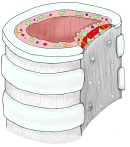 Wall of the trachea
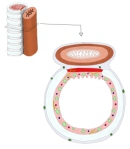 Trachea and esophagus (cross-section)
Reference websites
[Wikipedia]
· Trachealis muscle, Wikipedia.
[Websites with illustrations]
· Trachea: respiratory epithelium, hyaline cartilage and trachealis muscle (micrograph) (Indiana University School of Medicine, Virtual Microscopy)
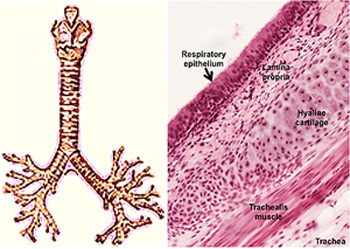
· Trachea (Kenhub)
Related terms
- Trachea
- Tracheal cartilages
- Tracheal glands
- Annular ligaments of trachea
- Tracheal bifurcation
- Esophagus
References and sources
- Further reading: Trachealis muscle, Wikipedia.
- Federative International Programme for Anatomical Terminology (FIPAT). Terminologia Anatomica, 2nd ed. (TA2), 2019.