Tubercle of upper lip (Latin: tuberculum labii superioris)
Also called the labial tubercle
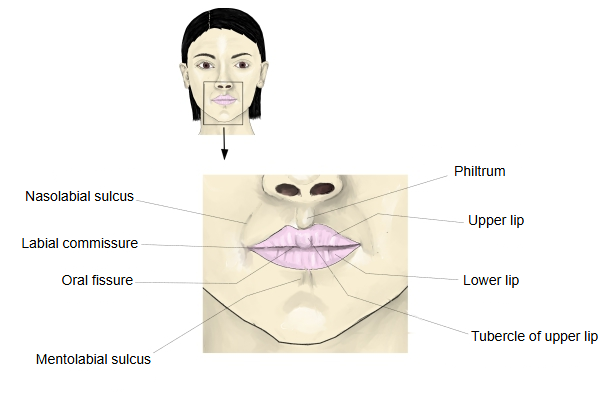
The tubercle of upper lip is the raised part in the midline of the transition part of the (anatomical) upper lip.
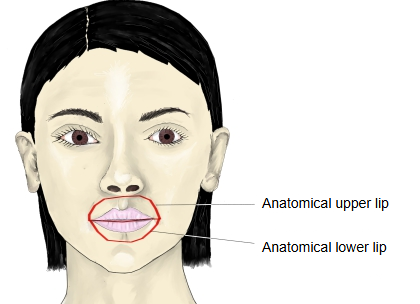
The anatomical lips have three parts: the skin part, the transition part and the mucosal partTransition part: the reddish part that everyday language calls "the lips" (the red part, vermilion)
The broad groove in the midline of the skin part of the upper lip is the philtrum. Where it reaches the free edge of the lip, the edge bulges downwards as the tubercle of upper lip. It belongs to the red part (vermilion) of the lip and presses on the lower lip in the midline when the mouth is closed.
- Skin part : like ordinary skin, with hair follicles, sweat glands and sebaceous glands; in men it carries the moustache and beard.
- Transition part : = transitional skin, between the skin part and the mucosal part ⇒ the part everyday language calls "the lips" (the red part, vermilion); the tubercle of upper lip lies here.
- Surface : covered by stratified squamous epithelium, very thin and non-keratinised or only thinly keratinised (sources differ); no hairs.
- Lamina propria : tall connective-tissue papillae rich in capillaries ⇒ the lips look red.
- Mucosal part : continuous with the oral mucosa (non-keratinised epithelium), with few papillae; contains the labial glands.
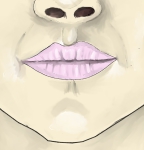 Lips
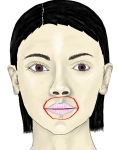 Anatomical lips
Reference websites
[Wikipedia]
· Lip, Wikipedia.
· Philtrum, Wikipedia.