Vascular lacuna (Latin: lacuna vasorum)
Note: some sources also name lymphatic vessels among the structures that pass through it.
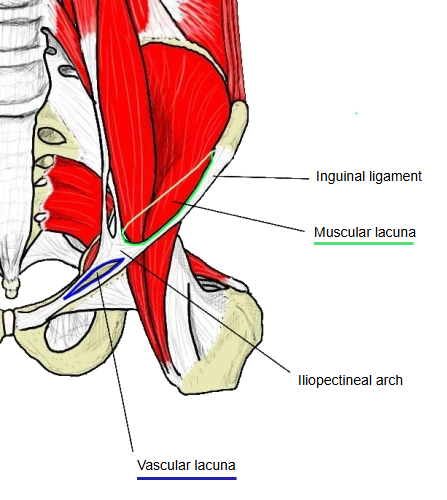
Its boundaries are the inguinal ligament in front, the superior border of the pubis (pecten pubis) behind, the iliopectineal arch laterally and the lacunar ligament medially. From lateral to medial it contains the femoral branch of the genitofemoral nerve, the femoral artery, the femoral vein and lymphatic vessels with a deep inguinal lymph node. The muscular lacuna carries the iliopsoas and the femoral nerve.
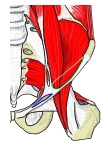 Muscular and vascular lacunae (anterior view)
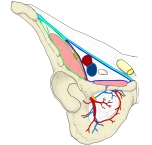 Contents of the lacunae
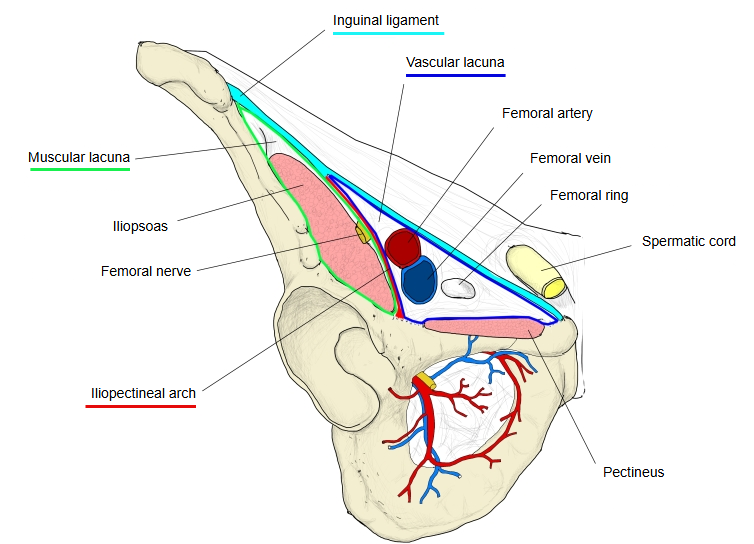
The femoral artery and vein and lymphatic vessels pass through the vascular lacuna: the femoral artery lies most laterally, the lymphatic vessels most medially, and the femoral vein between them. The artery and vein are enclosed in a single sheath of connective tissue (the femoral sheath), which has a more or less distinct septum between them, and they fill most of the lateral part of the lacuna. Between the vein and the concave edge of the lacunar ligament remains a gap, the femoral ring; a femoral hernia usually comes out through it.
Reference websites
[Wikipedia]
· Vascular lacuna, Wikipedia.
Related terms
- Inguinal ligament
- Lacunar ligament
- Femoral artery
- Femoral vein
- Femoral nerve
- Iliopsoas
- Saphenous opening
References and sources
- Further reading: Vascular lacuna, Wikipedia.
- Federative International Programme for Anatomical Terminology (FIPAT). Terminologia Anatomica, 2nd ed. (TA2), 2019.