Divisions of the Human Body
The human body is described in two ways: it is divided into a few large parts, and each part is further subdivided into smaller regions.
- Divisions of the human body
- Parts of the body The body is divided into large parts. On this site: the head and neck, the trunk and the limbs (upper and lower limbs).
- Regions of the body Based on the bones, muscles and organs, the parts are subdivided into more than 100 regions.
Parts of the body
Classical anatomy texts divided the body into only two parts, the trunk and the limbs, and counted the head and neck as part of the trunk. Most modern textbooks and atlases, as well as Terminologia Anatomica, treat the head and neck separately from the trunk, and this site follows that approach.
- The body has three main parts: the head and neck at the top, the trunk in the centre, and the limbs attached to the trunk.
- The limbs are the upper limb (the arm in everyday language) and the lower limb (the leg).
- The head and neck consists of the head and the neck.
- The trunk consists of the thorax (chest), the abdomen, the pelvis with the perineum, and the back.
- The upper limb consists of the shoulder, arm, forearm and hand.
- The lower limb consists of the hip and buttock (gluteal region), thigh, leg and foot.
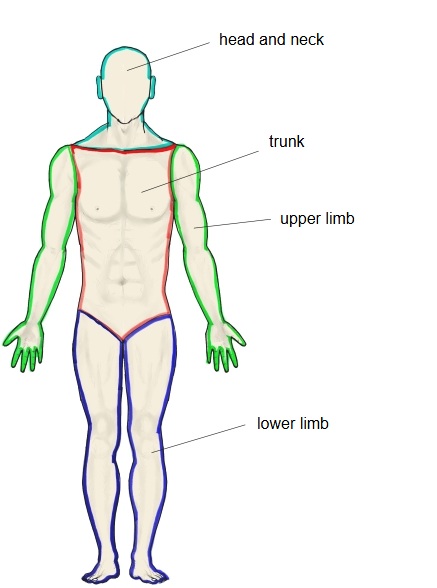
- Human body
- head and neck 1. head 2. neck
- trunk 1. thorax 2. abdomen 3. back 4. pelvis and perineum
- limbs
- upper limb 1. shoulder 2. arm 3. forearm 4. hand
- lower limb 1. gluteal region 2. thigh 3. leg 4. foot
The classical two-part division
In the classical division, the head and neck are counted as part of the trunk:
Head and neck as separate parts
Some atlases go further and list the head and the neck separately from the very beginning, and divide each limb into its girdle and its free part:
- Human body
- head
- neck
- trunk 1. thorax 2. abdomen 3. pelvis
- upper limb 1. shoulder girdle 2. free upper limb
- lower limb 1. pelvic girdle 2. free lower limb