Latin: musculi interossei dorsales pedis
Overview
- Four bipennate muscles, each arising by two heads from adjacent metatarsals.
- Their axis of abduction runs through the 2nd toe (in the hand, through the middle finger).
- By pulling the metatarsals together they also steady the forefoot.
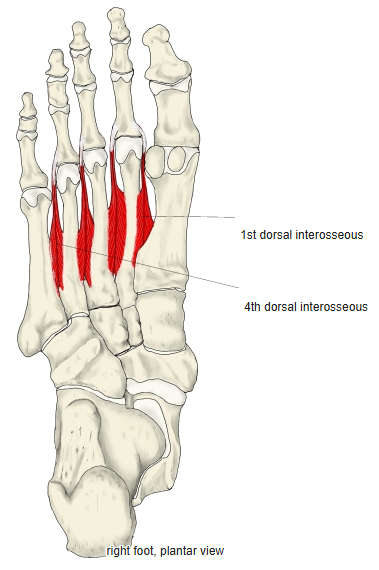
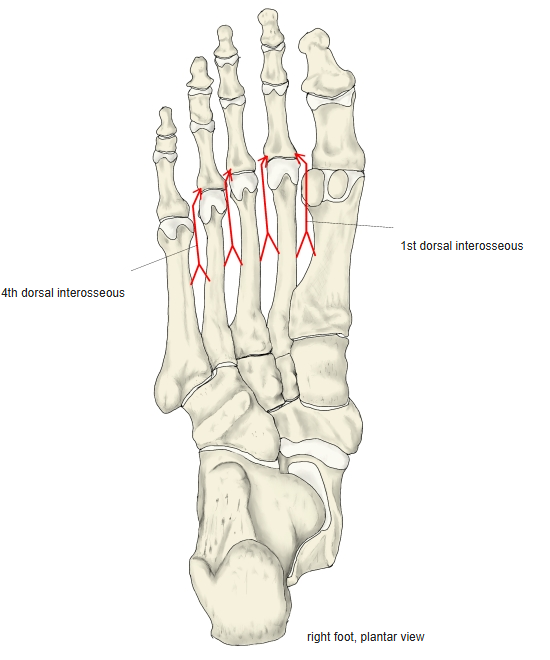
| Muscle | From (metatarsals) | To (proximal phalanx) |
|---|---|---|
| 1st dorsal interosseous | 1st and 2nd | 2nd toe, medial side |
| 2nd dorsal interosseous | 2nd and 3rd | 2nd toe, lateral side |
| 3rd dorsal interosseous | 3rd and 4th | 3rd toe, lateral side |
| 4th dorsal interosseous | 4th and 5th | 4th toe, lateral side |
Position in the classification
Lower Limb › Foot › Sole of foot › Metatarsal muscles
- Flexor digitorum brevis
- Quadratus plantae
- Lumbricals (foot)
- Dorsal interossei (foot)
- Plantar interossei
Illustrations
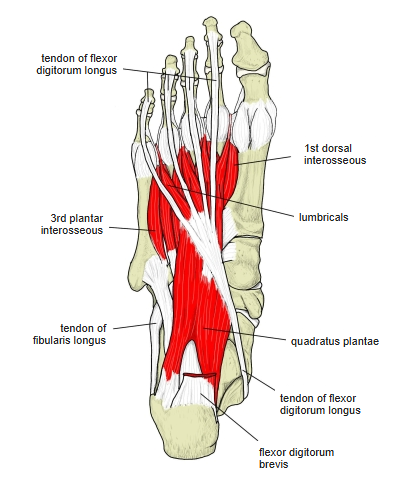
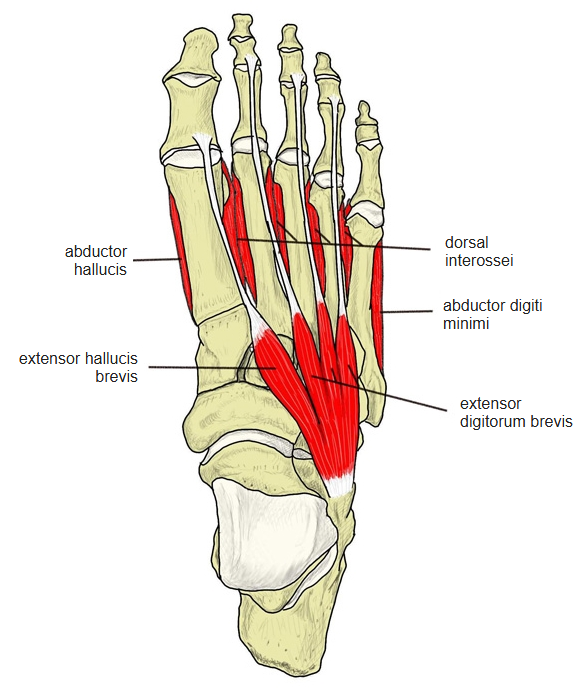
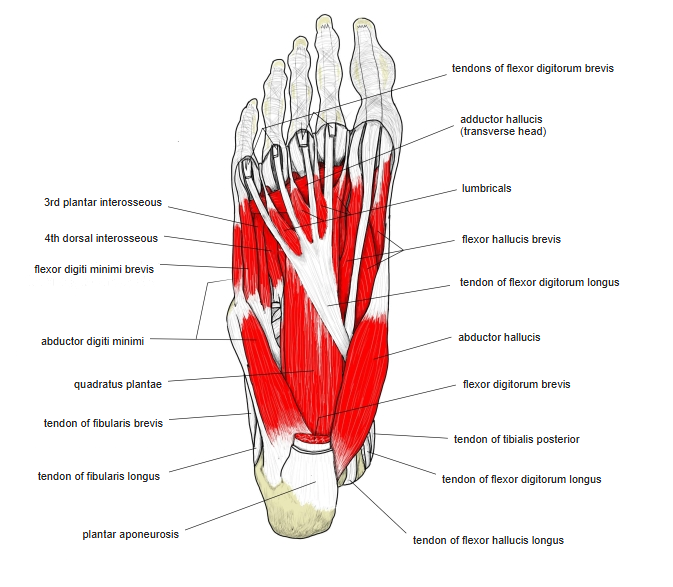
Origin / insertion
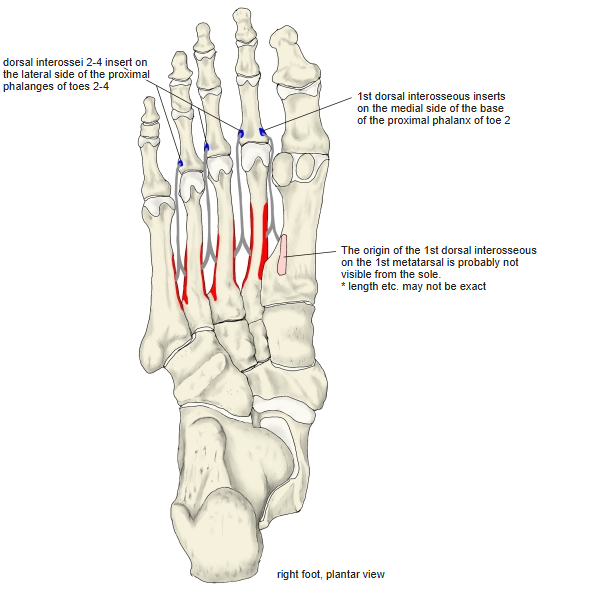
- Origin: each by two heads from the facing sides of the 1st–5th metatarsals (some sources add the long plantar ligament)
- Insertion: bases of the proximal phalanges
- 1st: medial side of the 2nd toe
- 2nd–4th: lateral side of the 2nd–4th toes
- Also into the dorsal digital expansions (the aponeuroses of the extensor digitorum longus tendons)
Action
- The 1st draws the 2nd toe medially and the 2nd–4th draw the 2nd–4th toes laterally, spreading the toes from the axis of the 2nd toe
- Some sources add flexion of the MTP joints and extension of the PIP and DIP joints of toes 2–4
Innervation
- Lateral plantar nerve (S1, S2; some sources S2, S3)
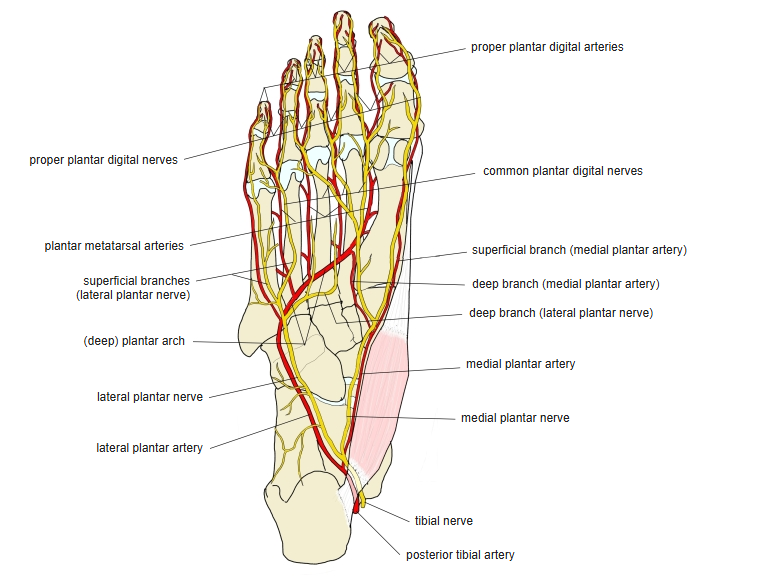
Blood supply
- Not given in the sources used here
Related terms
- Plantar interossei
- Lumbricals (foot)
- Dorsal interossei (hand)
- Lateral plantar nerve
References and sources
- Further reading: Dorsal interossei of the foot, Wikipedia.