Latin: musculus palatopharyngeus · also: palatopharyngeal muscle
Overview
- One of the five muscles of the soft palate and fauces.
- A long, fleshy muscle, narrower in the middle than at its ends; with the mucous membrane over it, it forms the palatopharyngeal arch, the fold behind the palatine tonsil.
- In the soft palate it is split into a posterior and an anterior fasciculus by the levator veli palatini and the musculus uvulae; each joins the fasciculus of the other side in the midline.
- Its lower part is divided into a lateral part and a medial part.
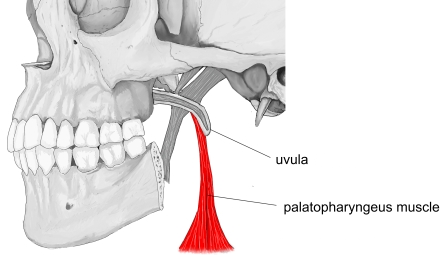
Position in the classification
Head › Muscles of the soft palate and fauces
- Tensor veli palatini
- Levator veli palatini
- Uvular muscle
- Palatoglossus
- Palatopharyngeal muscle
Illustrations
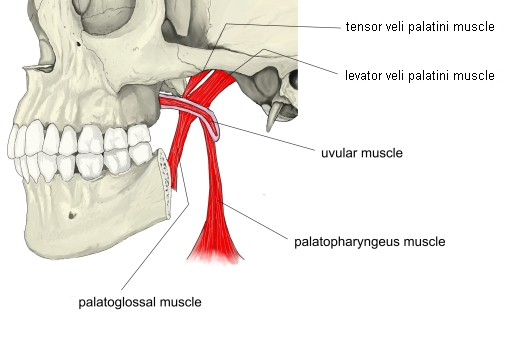
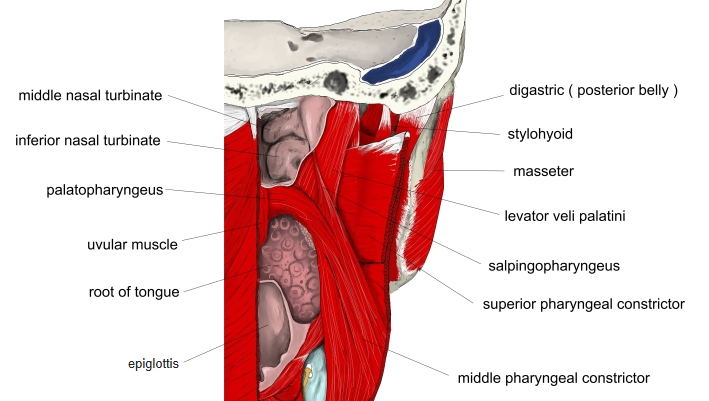
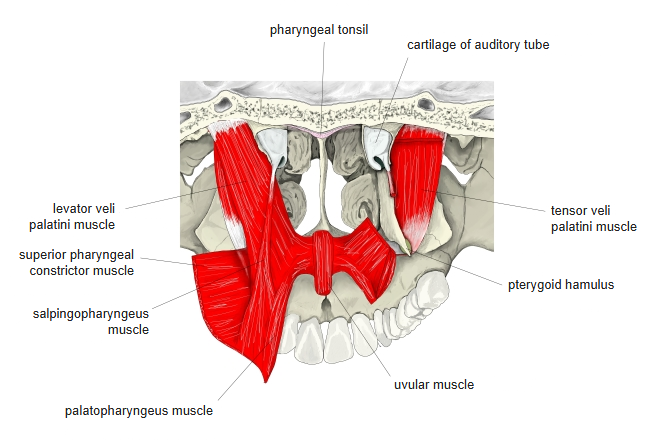
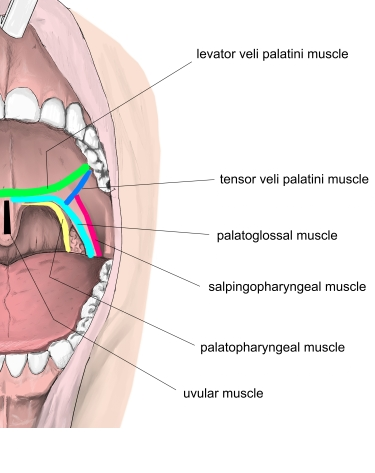
The last figure mainly shows the course of the muscles of the palate.
Origin / insertion
- Origin: the palatine aponeurosis and the posterior border of the hard palate (some fibres from the cartilage of the auditory tube)
- Runs laterally and downward inside the palatopharyngeal arch, behind the palatine tonsil, and joins the stylopharyngeus.
- Insertion:
- Lateral part: posterior border of the lamina of the thyroid cartilage
- Medial part: pharyngeal raphe of the posterior wall of the pharynx
- The fibres spread out widely in the mucous membrane of the pharynx; some cross the midline to the other side.
Action
- Pulls the soft palate downward
- In swallowing, the muscles of both sides draw the pharynx upward over the food bolus and move toward each other, the uvula filling the gap between them; this keeps the bolus out of the nasopharynx and guides it down into the lower pharynx.
Innervation
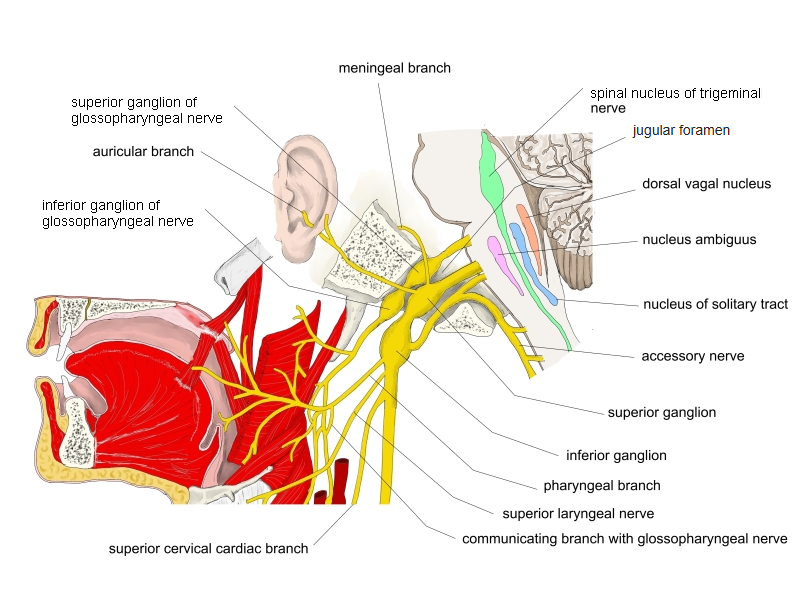
- Pharyngeal branch of the vagus nerve through the pharyngeal plexus
Blood supply
- Branches of the facial artery
Compiled from standard anatomy references.
Related terms
- Muscles of the soft palate and fauces
- Palatoglossus
- Levator veli palatini
- Tensor veli palatini
- Musculus uvulae
- Stylopharyngeus
- Palatopharyngeal arch
- Palatine tonsil
- Soft palate
- Pharyngeal plexus
References and sources
- Further reading: Palatopharyngeus muscle, Wikipedia — also the source for the blood supply.