Latin: musculus palatoglossus · also: glossopalatinus, palatoglossal muscle
Overview
- One of the five muscles of the soft palate and fauces; a few sources count it as an extrinsic muscle of the tongue.
- A small muscle, narrower in the middle than at its ends; with the mucous membrane over it, it forms the palatoglossal arch, the fold in front of the palatine tonsil.
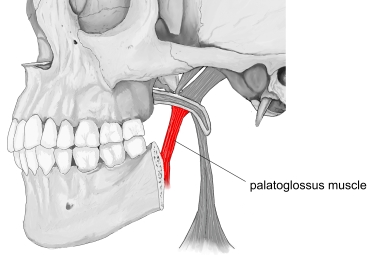
Position in the classification
Head › Muscles of the soft palate and fauces
Illustrations
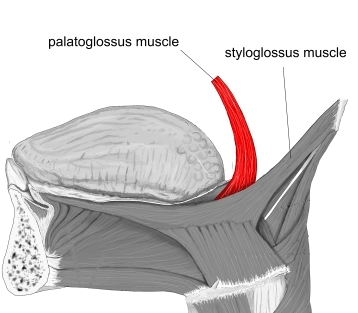
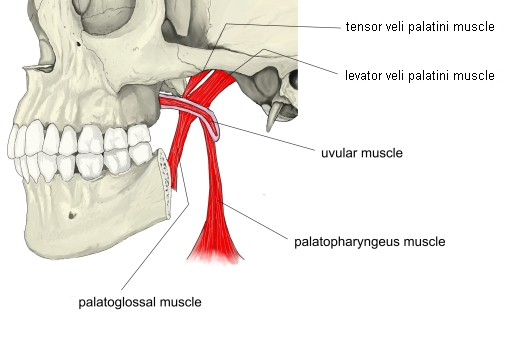
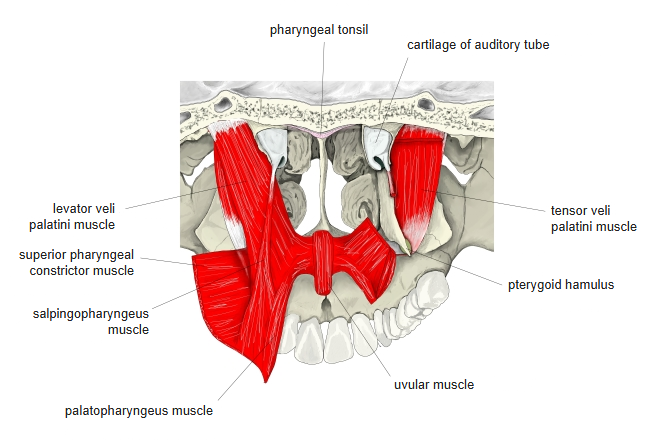
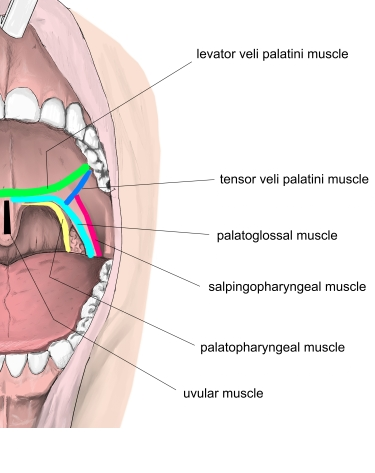
Origin / insertion
Sources describe the attachments in opposite directions.
- Also described as arising from the lateral border of the tongue, continuing from the transverse muscle of the tongue; it runs up inside the palatoglossal arch to the soft palate, where it interlaces with the muscle of the other side.
- English sources: arises from the palatine aponeurosis of the soft palate (continuous with the muscle of the other side) and runs downward, forward and laterally in front of the palatine tonsil to the side of the tongue; some fibres spread over the dorsum, others mingle with the transverse muscle of the tongue.
Action
- Raises the back of the tongue
- Closes the fauces (the oropharyngeal isthmus) and helps to start swallowing
- By keeping the palatoglossal arch in place it stops saliva spilling from the mouth into the oropharynx.
Innervation
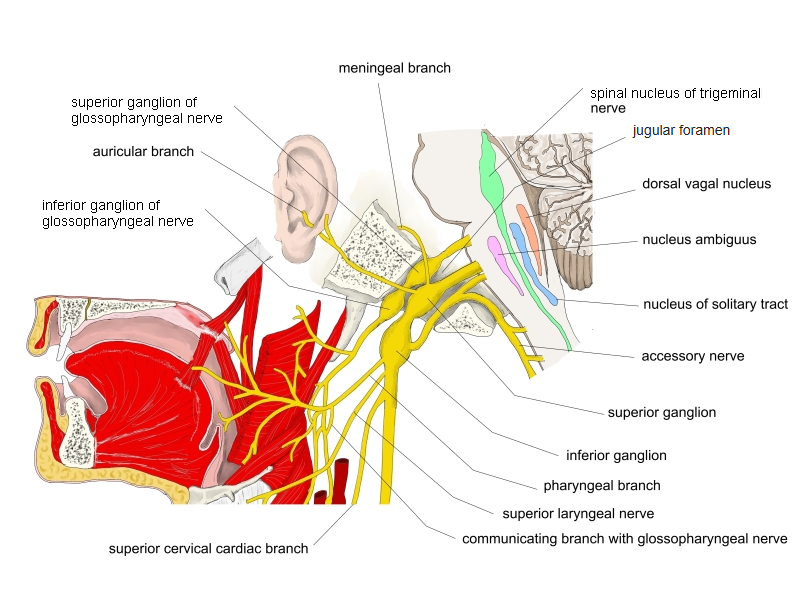
- Vagus nerve (pharyngeal branch, through the pharyngeal plexus)
- The only tongue-related muscle not supplied by the hypoglossal nerve.
- Some sources attribute the fibres to the cranial part of the accessory nerve or to the glossopharyngeal nerve, both reaching the muscle through the pharyngeal plexus.
Blood supply
- Not stated in the sources used here.
Related terms
- Muscles of the soft palate and fauces
- Palatoglossal arch
- Palatine tonsil
- Palatine aponeurosis
- Soft palate
- Styloglossus
- Transverse muscle of the tongue
- Palatopharyngeus
- Pharyngeal plexus
References and sources
- Further reading: Palatoglossus muscle, Wikipedia.