Latin: musculus pectoralis major
Overview
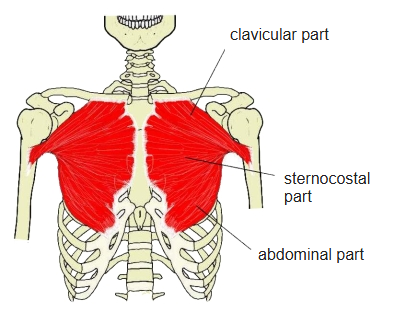
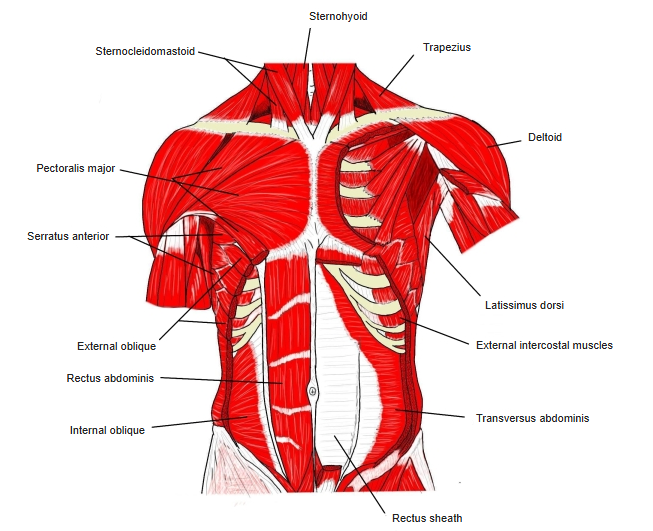
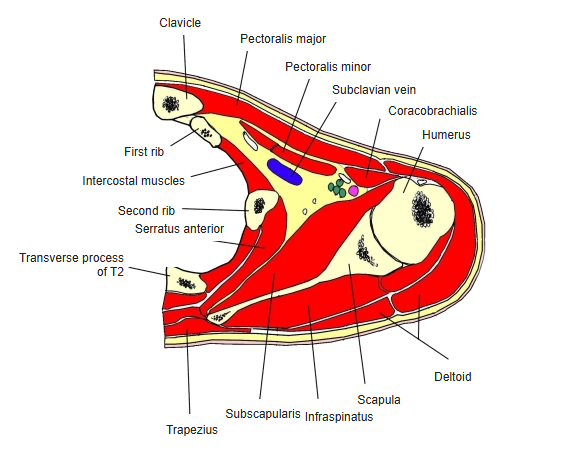
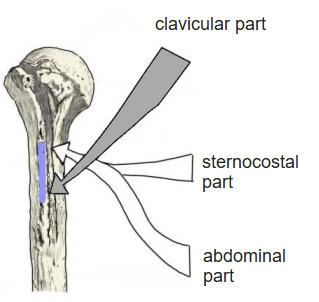
- A thick, fan-shaped muscle of the chest in three parts: clavicular, sternocostal and abdominal.
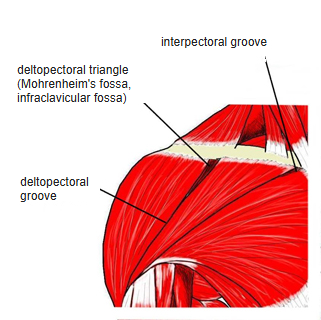
- It forms three grooves or spaces:
- Interpectoral groove: between the clavicular and sternocostal parts
- Deltopectoral groove: between the deltoid and the clavicular part
- Deltopectoral triangle (infraclavicular fossa): a hollow bounded by the clavicle, the deltoid and the clavicular part
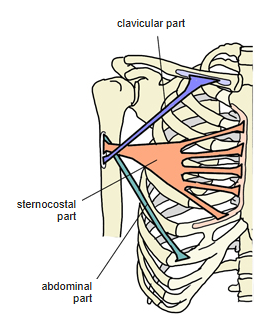
- At the insertion the clavicular part ends lowest, while the sternocostal and abdominal parts cross behind it and end higher, so the tendon looks twisted.
- A sternalis muscle occasionally lies on the surface of the origin.
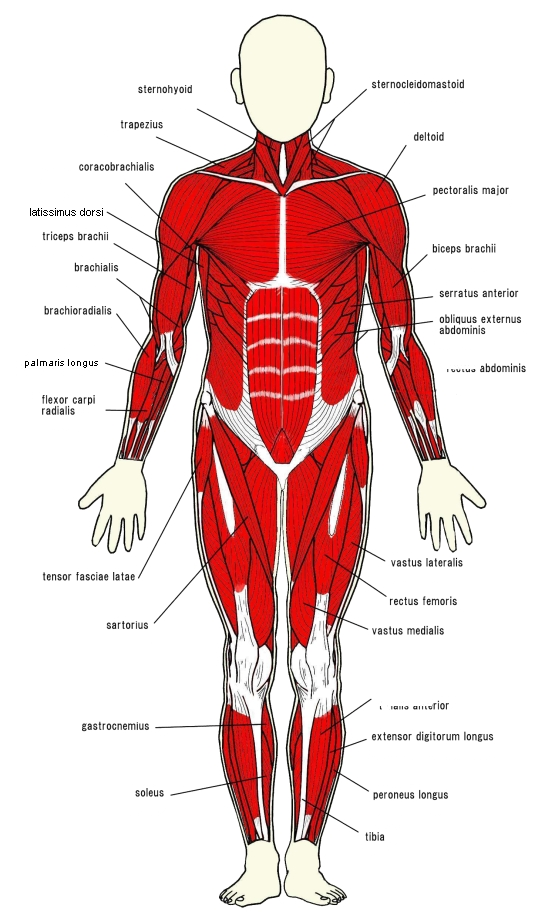
- Continuous in places with the rectus abdominis, deltoid, sternocleidomastoid and the pectoralis major of the other side.
Position in the classification
Trunk › Thorax › Superficial muscles of the thorax
- Pectoralis major
- Pectoralis minor
- Subclavius
- Serratus anterior
Illustrations
Origin / insertion
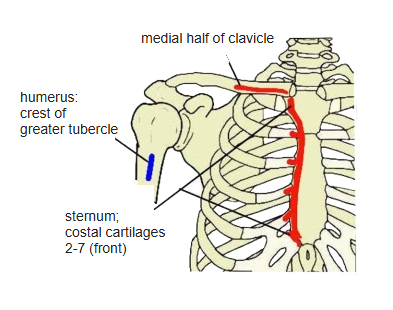
- Origin:
- Clavicular part: medial half of the clavicle
- Sternocostal part: lateral border of the manubrium and body of the sternum, anterior surfaces of the 2nd–7th costal cartilages
- Abdominal part: anterior layer of the rectus sheath
- Insertion: crest of the greater tubercle of the humerus (about 5 cm wide; Wikipedia)
Action
- Adducts and medially rotates the arm
- With the arm fixed, raises the sternum and ribs
Innervation
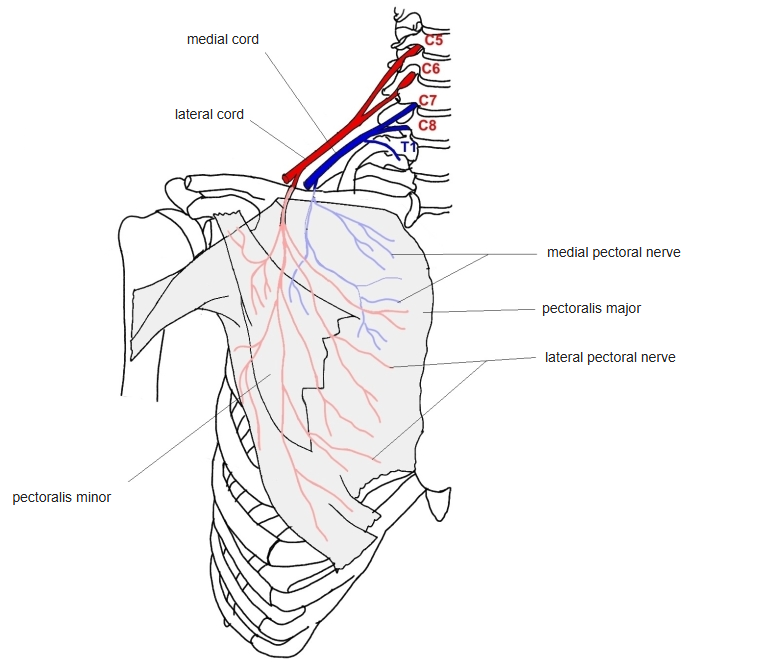
- Medial pectoral nerve (C8, T1) and lateral pectoral nerve (C5–C7)
Blood supply
- Not given in the sources used here
Related terms
- Pectoralis minor
- Deltoid
- Sternalis
- Clavicle
- Sternum
- Humerus
- Medial pectoral nerve
- Lateral pectoral nerve
References and sources
- Further reading: Pectoralis major muscle, Wikipedia.