Latin: musculus pectoralis minor
Overview
- One of the four superficial muscles of the thorax.
- A thin, flat, triangular muscle on the front of the chest wall, completely covered by the pectoralis major.
- Covered in front by the clavipectoral fascia; develops from the same primordium as the pectoralis major.
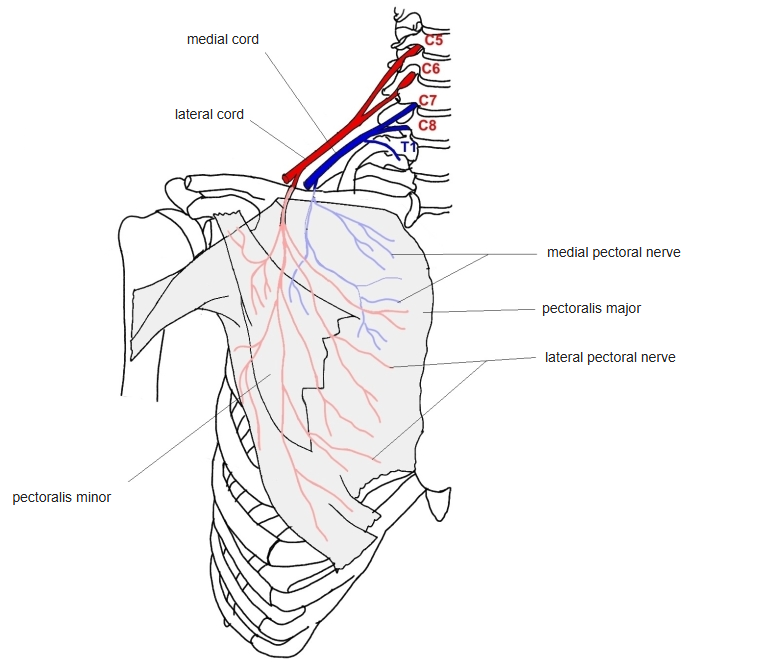
- The brachial plexus, axillary artery and axillary vein pass beneath it; the medial pectoral nerve pierces it.
- It divides the axillary artery into three parts (1st medial to it, 2nd behind it, 3rd lateral to it); the axillary lymph nodes are also grouped by their position relative to it.
- Its insertion can just be seen in the deltopectoral triangle, and part of it can be palpated there directly.
- Continuous in places with the internal intercostal muscles and the coracobrachialis.
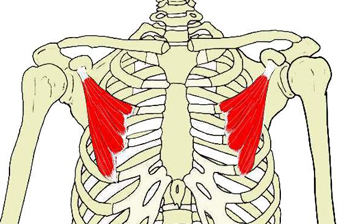
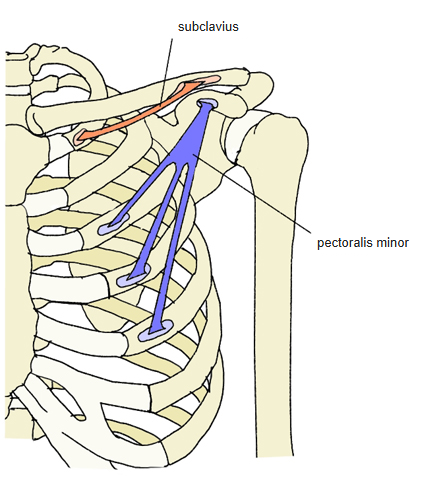
Position in the classification
Trunk › Thorax › Superficial muscles of the thorax
- Pectoralis major
- Pectoralis minor
- Subclavius
- Serratus anterior
Illustrations
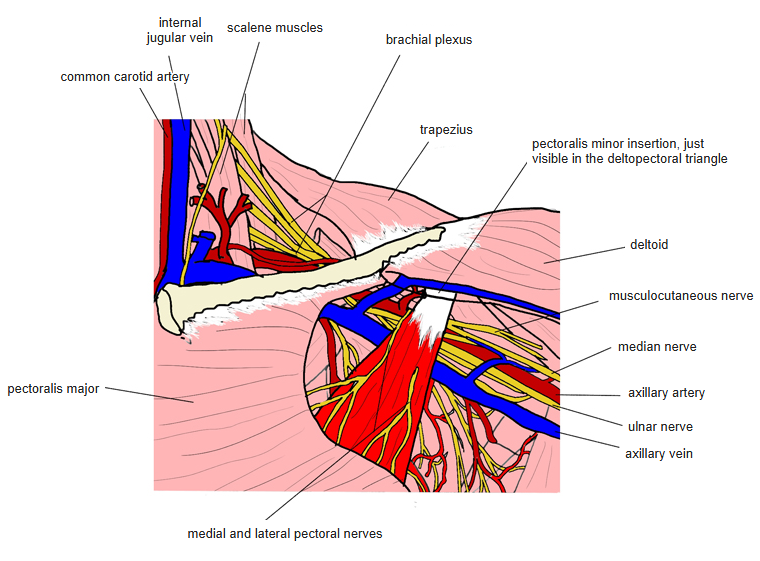
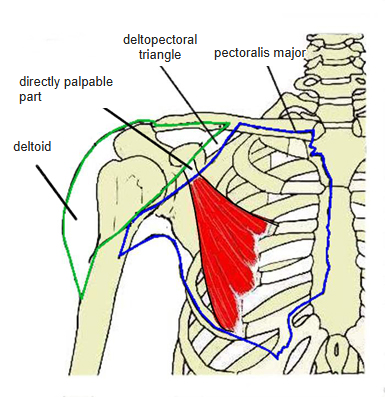
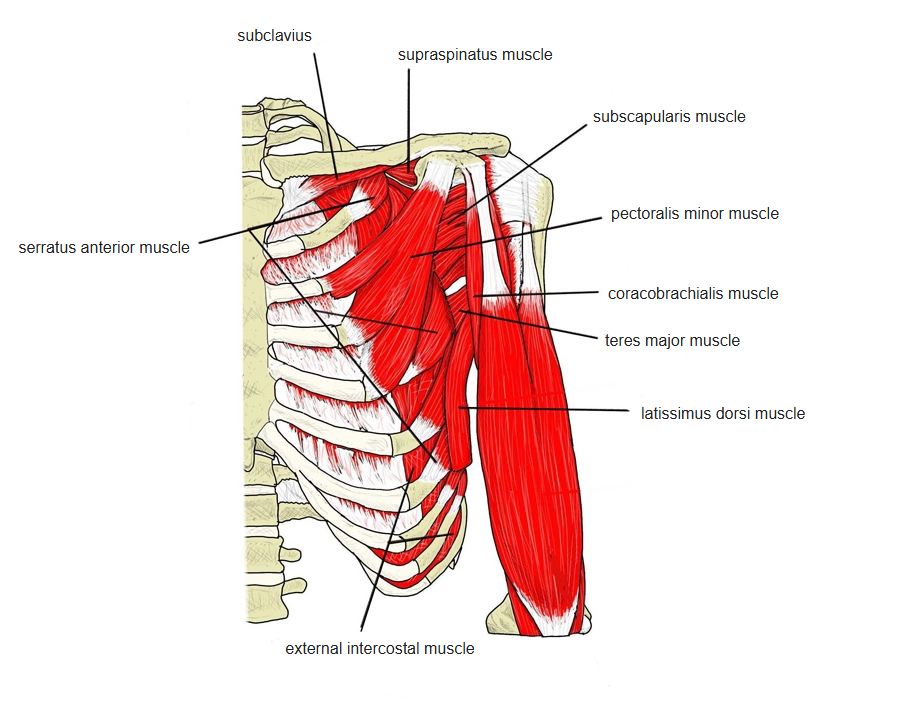
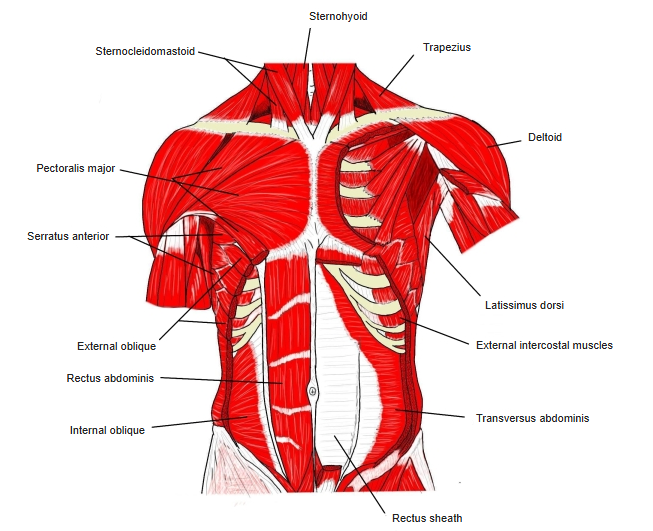
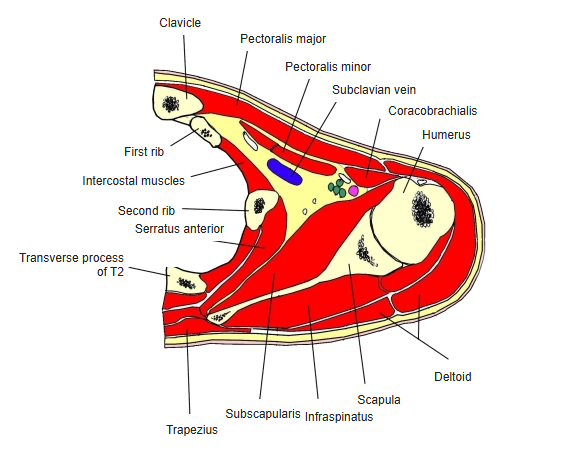
Origin / insertion
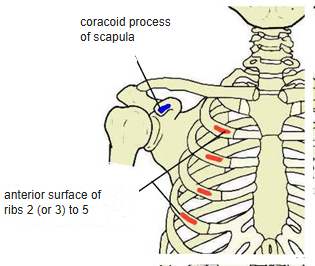
- Origin: anterior surfaces of ribs 2 (or 3) to 5, near their cartilages, and the aponeuroses over the intercostal muscles
- The fibres run upward and laterally and converge on a flat tendon.
- Insertion: coracoid process of the scapula (medial border and upper surface)
Action
- Pulls the lateral angle of the scapula downward and forward toward the ribs
- With the scapula fixed, raises ribs 2 (or 3) to 5 and widens the thorax (accessory muscle of respiration)
Innervation
- Sources differ:
- Pectoral nerves
- Medial and lateral pectoral nerves (C7–C8, sometimes T1)
- Medial and lateral pectoral nerves (C6–T1)
- Medial pectoral nerve only (C7–C8)
Blood supply
- Not stated in the sources used here.
Anatomical variations
- May be absent (for example in Poland syndrome); rarely doubled
- The number of origin slips varies from one to five (ribs 2–6)
- The tendon may continue over the coracoid process to the shoulder-joint capsule, the infraspinatus tendon, the coracoacromial ligament or the greater tubercle (reported more often in Chinese than in European series)
- May be joined to the pectoralis major or the subclavius
- A slip from rib 1 to the coracoid process is called the pectoralis minimus
Related terms
- Superficial muscles of the thorax
- Pectoralis major
- Subclavius
- Coracoid process
- Clavipectoral fascia
- Medial pectoral nerve
- Lateral pectoral nerve
- Brachial plexus
- Axillary artery
- Axillary vein
- Deltopectoral triangle
References and sources
- Further reading: Pectoralis minor, Wikipedia.