Latin: integumentum commune
Overview
- The outer covering of the body: the skin and its derivatives (appendages).
- The largest organ of the body – about 1.6–1.8 m² and some 15% of body weight in the adult.
- Protects against injury, water loss and microbes; helps to regulate body temperature; and acts as a large sense organ for touch, pressure, temperature and pain.
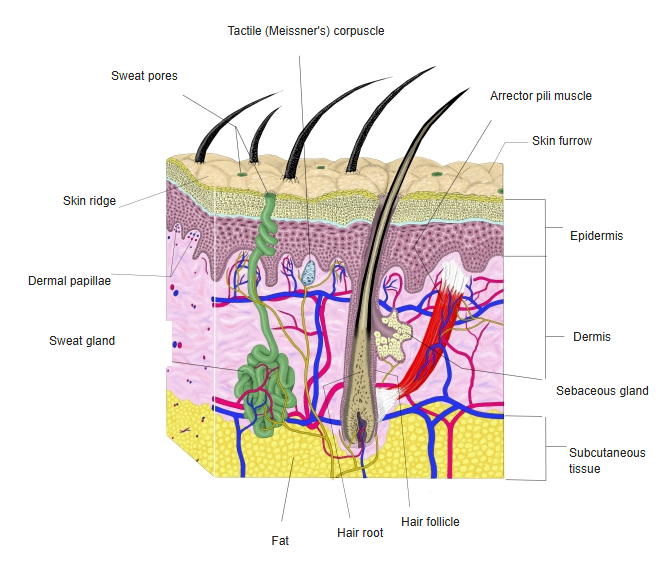
Skin, block diagram
Pages on the integument
Parts of the integument
| Part | Main features |
|---|---|
| Skin | Three layers: epidermis (keratinized stratified squamous epithelium), dermis (dense connective tissue) and subcutaneous tissue (loose tissue with fat) |
| Hair | Keratinized threads formed in hair follicles; protection and touch |
| Nails | Hard keratin plates on the dorsal surface of the fingertips and toe tips |
| Skin glands | Sweat glands (eccrine and apocrine) and sebaceous glands |
| Breast | Contains the mammary gland, a modified skin gland |
References and sources
- Further reading: Integument, Wikipedia.