Condyle of humerus (Latin: condylus humeri)
Also called the humeral condyle
Sources differ on the extent of the condyle of humerus; two definitions are in use.
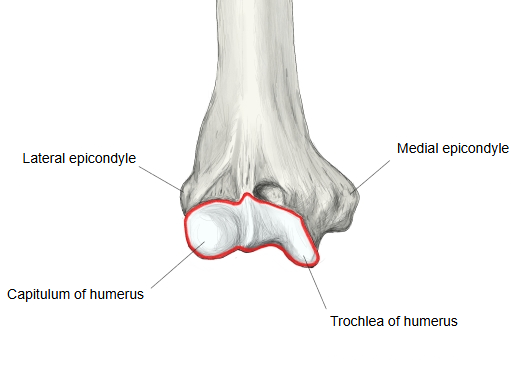
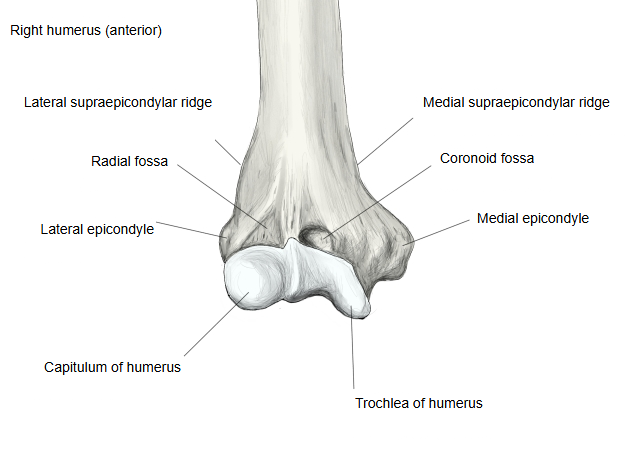
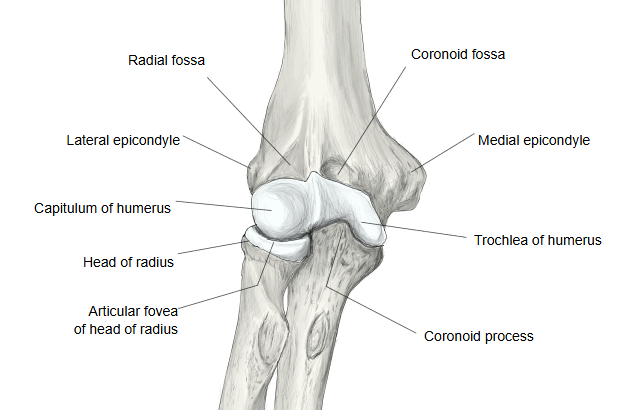
In this narrow sense the condyle of humerus consists of the pulley-shaped trochlea medially, which articulates with the ulna, and the rounded capitulum laterally, which articulates with the head of the radius. The capitulum is limited to the front and lower surface and hardly reaches the back of the humerus, whereas the trochlea wraps round the lower end from front to back.
Some textbooks describe it as the articular head on the lower surface of the distal epiphysis, between the medial and lateral epicondyles, by which the humerus articulates with the radius and the ulna; a low ridge and a shallow groove divide it into a medial part (the trochlea) and a lateral part (the capitulum).
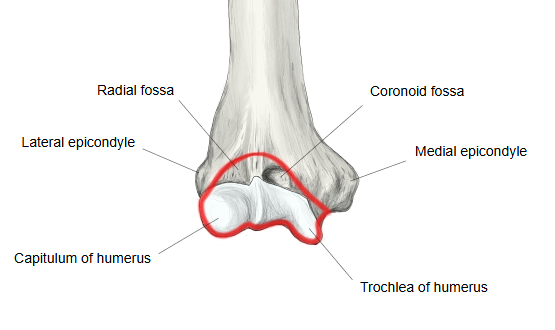
Some English medical dictionaries use this wider sense: the distal end of the humerus, including the trochlea and capitulum and the olecranon, coronoid and radial fossae.
Some anatomy texts likewise call the whole lower end of the humerus between the medial and lateral epicondyles the condyle of humerus.
 Right humerus (lower end)
 Right elbow joint (anterior)
Reference websites
[Wikipedia]
· Humerus, Wikipedia.
[Websites with illustrations]
· The humerus (TeachMeAnatomy)
Where it is found
Related terms
- Trochlea of humerus
- Capitulum of humerus
- Medial epicondyle
- Lateral epicondyle
- Coronoid fossa
- Radial fossa
- Olecranon fossa
References and sources
- Further reading: Humerus, Wikipedia.
- Federative International Programme for Anatomical Terminology (FIPAT). Terminologia Anatomica, 2nd ed. (TA2), 2019.