Lateral epicondyle (Latin: epicondylus lateralis humeri)
Also called the lateral epicondyle of humerus
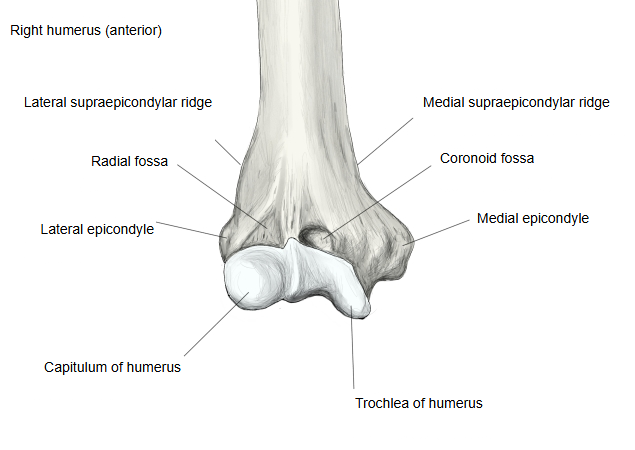
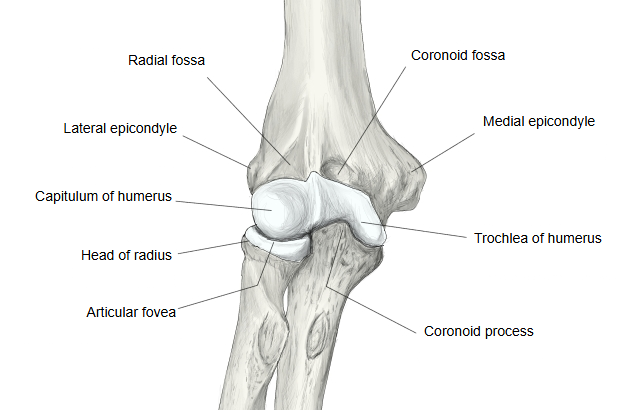
· It is the main origin of the extensor muscles of the forearm (common extensor origin): extensor carpi radialis brevis, extensor digitorum, extensor digiti minimi and extensor carpi ulnaris. Supinator and anconeus also arise from it, and extensor carpi radialis longus arises just above it, from the lateral supracondylar ridge. The radial collateral ligament of the elbow is attached to it. It can be felt on the outer side of the elbow; overuse of the extensors at their origin causes lateral epicondylitis (tennis elbow).
· The femur also has a projection of the same name: the lateral epicondyle of femur.
· On the opposite, medial side lies the medial epicondyle, which projects much further than the lateral epicondyle.
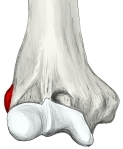 Right humerus (anterior)
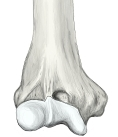 Lower end of humerus (anterior)
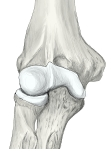 Right elbow joint (anterior)
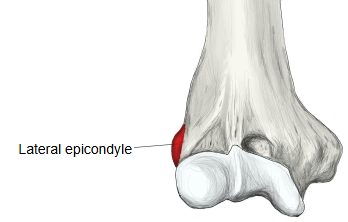
Reference websites
[Wikipedia]
· Lateral epicondyle of the humerus, Wikipedia.
· Tennis elbow, Wikipedia.
Where it is found
Related terms
- Medial epicondyle
- Lateral supracondylar ridge
- Capitulum of humerus
- Condyle of humerus
- Lower end of humerus
- Humeroradial joint
- Lateral epicondyle of femur
References and sources
- Further reading: Lateral epicondyle of the humerus, Wikipedia.
- Further reading: Tennis elbow, Wikipedia.
- Federative International Programme for Anatomical Terminology (FIPAT). Terminologia Anatomica, 2nd ed. (TA2), 2019.