Groove for radial nerve (Latin: sulcus nervi radialis)
Also called the radial groove or the spiral groove
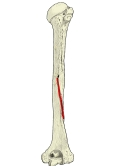 Right humerus (posterior)
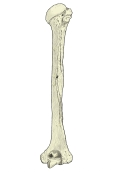 Right humerus (posterior)
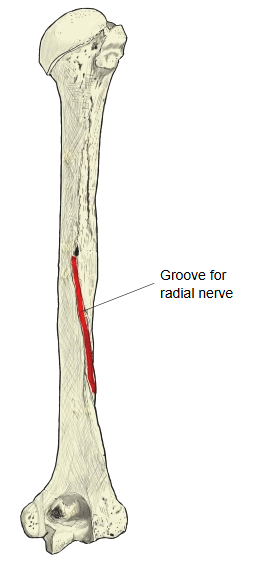
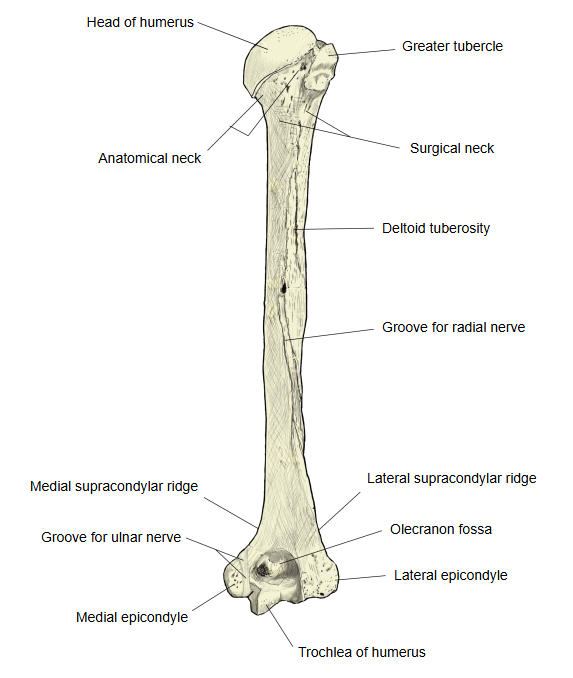
· It runs downwards and laterally across the posterior surface of the middle third of the shaft, behind the deltoid tuberosity.
· It lodges the radial nerve and the deep brachial (profunda brachii) vessels as they pass round the back of the humerus.
· It lies between the origins of triceps brachii: the lateral head arises above and lateral to it, the medial head below and medial to it.
· The groove is often indistinct. Because the radial nerve lies against the bone here, a fracture of the middle of the humeral shaft can injure it, causing weakness of the wrist and finger extensors (wrist drop).
Reference websites
[Wikipedia]
· Radial groove, Wikipedia.
· Radial nerve, Wikipedia.
[Websites with illustrations]
· Radial sulcus on the left humerus, posterior view (Wikimedia Commons)

· Radial groove of the humerus (Wikimedia Commons)

· The radial nerve (TeachMeAnatomy)
Where it is found
Related terms
References and sources
- Further reading: Radial sulcus, Wikipedia.
- Further reading: Humerus, Wikipedia.
- Federative International Programme for Anatomical Terminology (FIPAT). Terminologia Anatomica, 2nd ed. (TA2), 2019.