Latin: ganglion sensorium
Overview
- A ganglion containing the cell bodies of sensory (afferent) neurons; there are no synapses in it.
- Two groups: the spinal (dorsal root) ganglia of the spinal nerves and the sensory ganglia of the cranial nerves.
- Their neurons are pseudounipolar (bipolar in the vestibular and spiral ganglia).
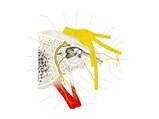
Facial nerve in the temporal bone 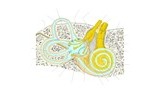
Vestibulocochlear nerve and the inner ear
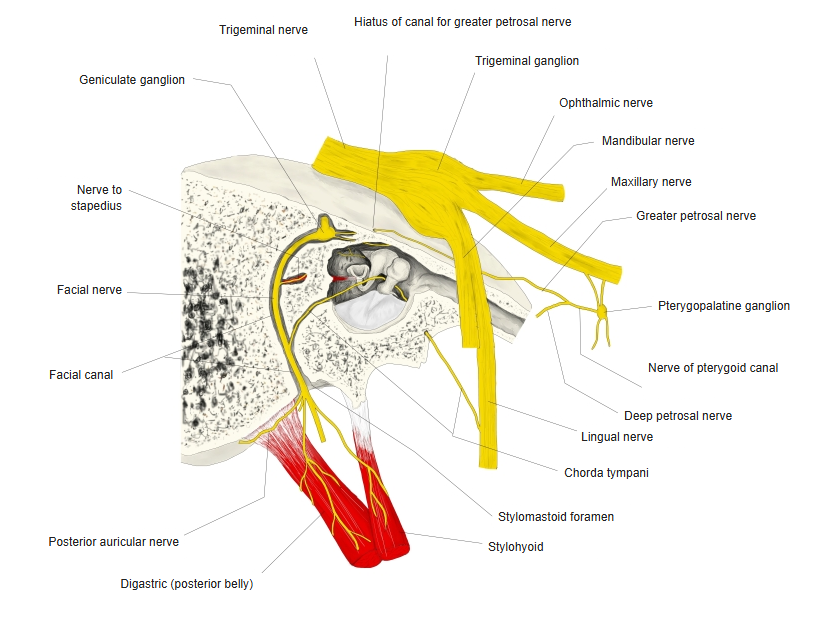
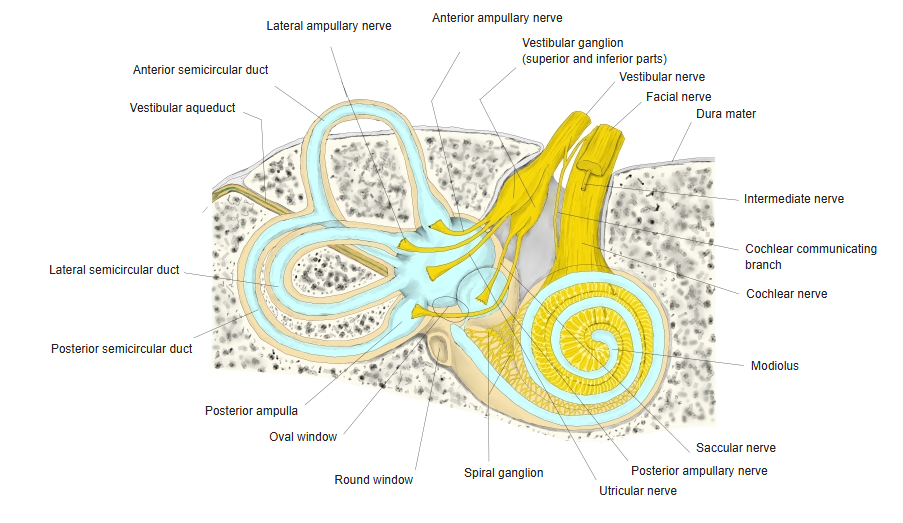
Sensory ganglia of the cranial nerves
| Ganglion | Nerve | Position |
|---|---|---|
| Trigeminal (semilunar) ganglion | Trigeminal nerve (ophthalmic, maxillary, mandibular nerves) | Trigeminal impression near the apex of the petrous part of the temporal bone |
| Geniculate ganglion | Facial nerve | At the genu of the facial nerve |
| Vestibular (Scarpa) ganglion | Vestibular part of the vestibulocochlear nerve | Internal acoustic meatus |
| Spiral ganglion | Cochlear nerve | Modiolus of the cochlea |
| Superior ganglion of glossopharyngeal nerve | Glossopharyngeal nerve | Upper part of the jugular foramen |
| Inferior (petrosal) ganglion of glossopharyngeal nerve | Glossopharyngeal nerve | Lower part of the jugular foramen |
| Superior (jugular) ganglion of vagus nerve | Vagus nerve | Jugular foramen |
| Inferior (nodose) ganglion of vagus nerve | Vagus nerve | Just below the jugular foramen |
References and sources
- Further reading: Sensory ganglion, Wikipedia.