Latin: musculus serratus anterior
Overview
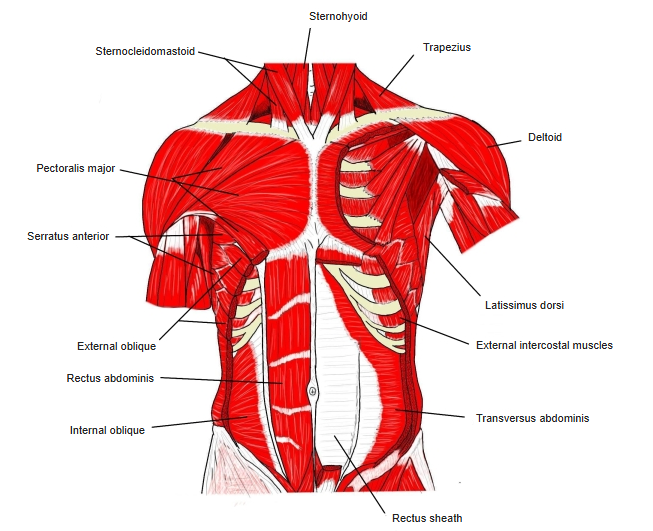
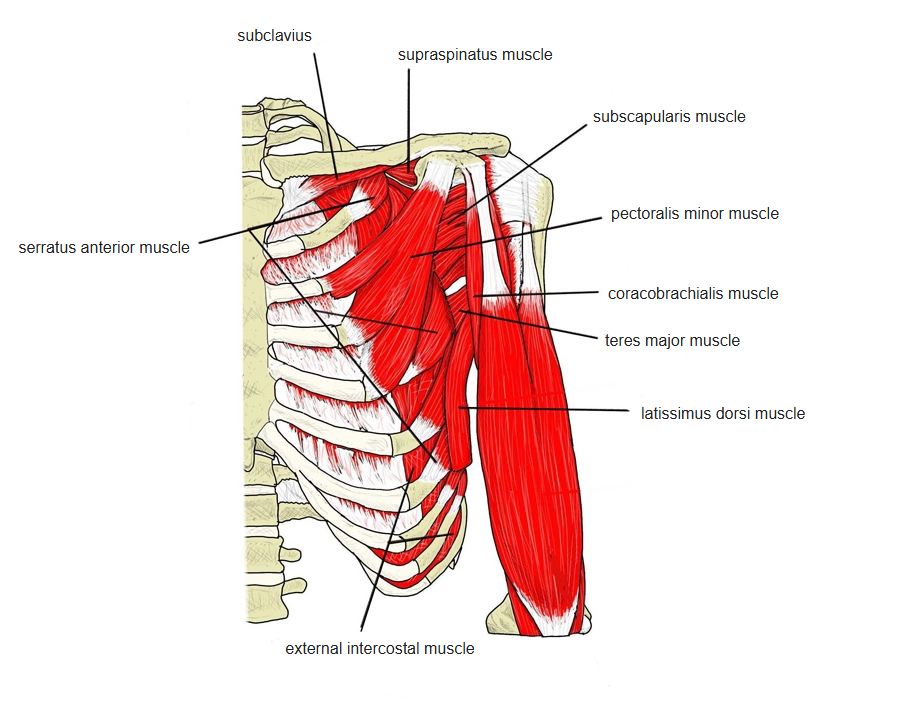
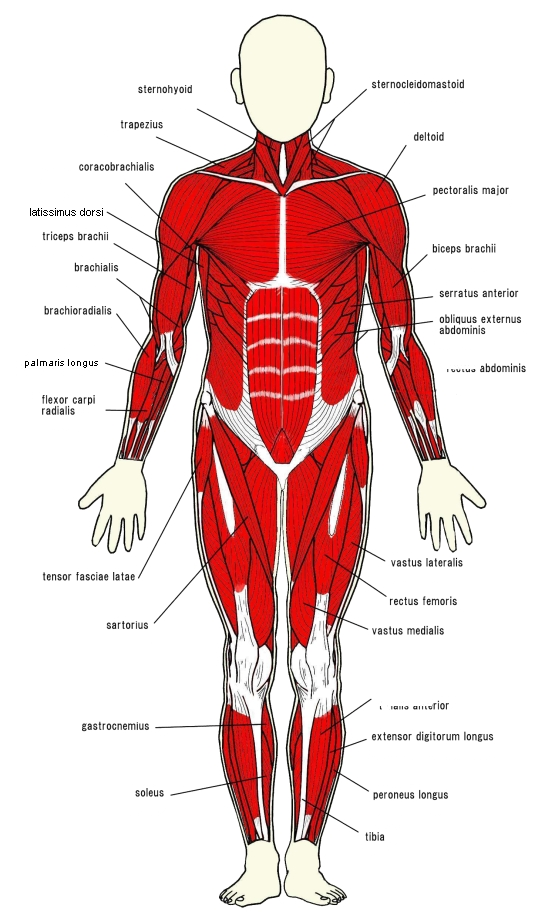
- One of the four superficial muscles of the thorax, on the side of the chest.
- Works when throwing a punch, hence the nickname “boxer's muscle”. The name comes from Latin serrare, to saw.
- Its origin has shifted secondarily to the side of the trunk during development.
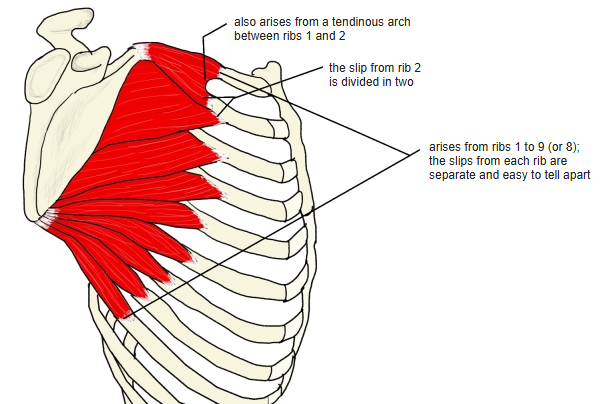
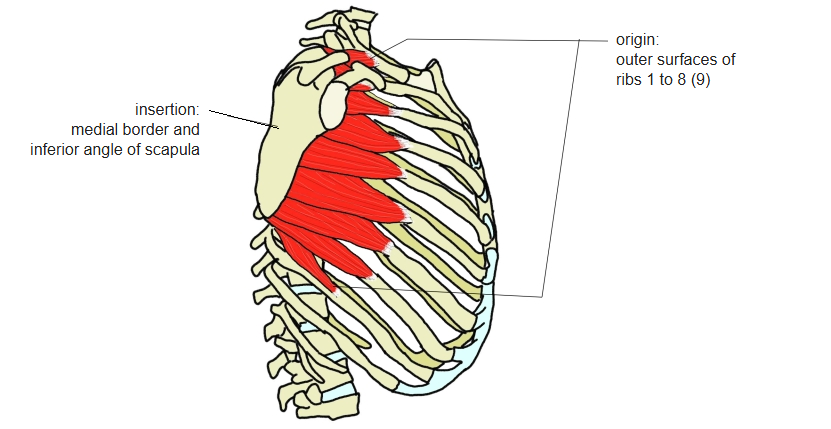
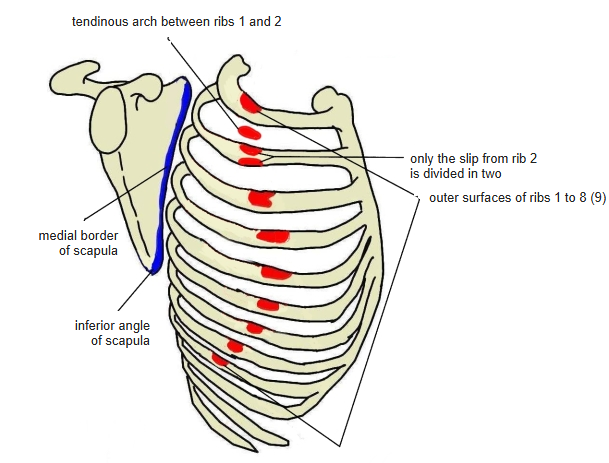
- The slips from each rib are separate and easy to tell apart; the slip from rib 2 is divided in two, so there is one more slip than ribs.
- Sometimes divided by insertion into superior, intermediate and inferior parts.
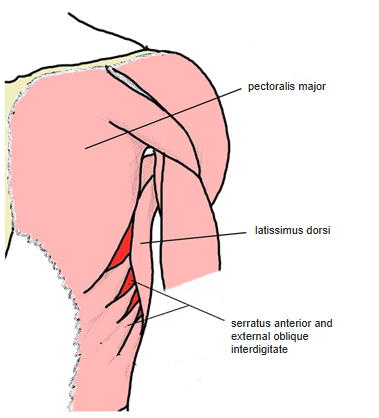
- At the lower border it interdigitates with the external oblique.
- Continuous in places with the rhomboids, levator scapulae and external oblique.
Position in the classification
Trunk › Thorax › Superficial muscles of the thorax
- Pectoralis major
- Pectoralis minor
- Subclavius
- Serratus anterior
Illustrations
Origin / insertion
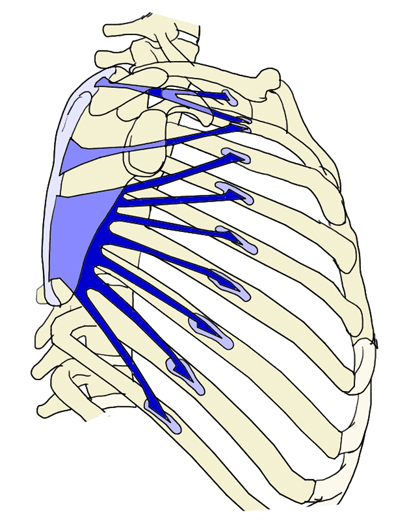
- Origin: outer surfaces of ribs 1 to 8 (9) and a tendinous arch between ribs 1 and 2
- Insertion: medial border and inferior angle of the scapula
Action
- Pulls the scapula forward around the thorax
- With the scapula fixed, pulls the ribs upward and outward
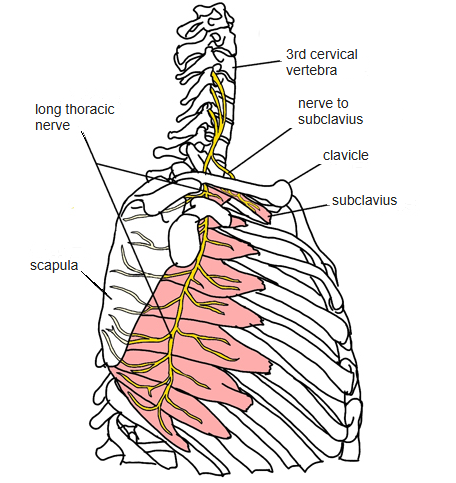
Innervation
- Long thoracic nerve (C5–C7)
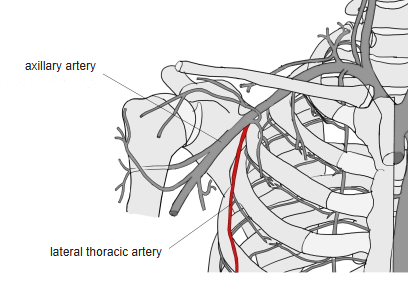
Blood supply
- Lateral thoracic artery, thoracodorsal artery
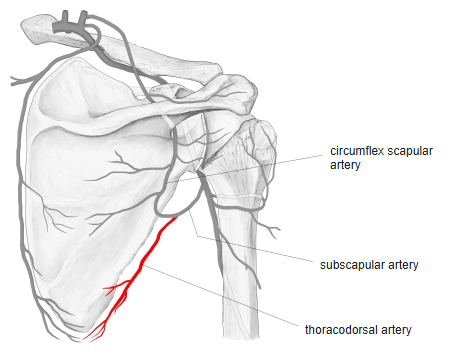
Anatomical variations
- Parts may be missing
- The number of slips varies from 7 to 11
- May be joined to the external intercostals or external oblique
Related terms
- Superficial muscles of the thorax
- Rhomboid major
- Rhomboid minor
- Levator scapulae
- External oblique
- Scapula
- Long thoracic nerve
- Lateral thoracic artery
- Thoracodorsal artery
References and sources
- Further reading: Serratus anterior muscle, Wikipedia.