Latin: pelvis renalis
Overview
- Funnel-shaped sac formed by the union of the major calyces, lying in the renal sinus.
- Narrows at the hilum and continues as the ureter.
- Urine flow: renal papilla → minor calyx → major calyx → renal pelvis → ureter.
- The name is from Latin *pelvis*, "basin"; "renal" separates it from the bony pelvis.
Section of the kidney
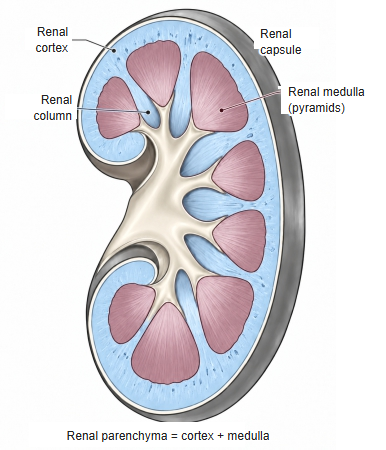
Shape and structure
- Shape: a branched type with distinct, long major calyces, or an ampullary type with short calyces and a wide pelvis.
- At the hilum the structures lie, from front to back: renal vein, renal artery, renal pelvis.
- Wall: mucosa lined by transitional epithelium (urothelium), a smooth-muscle coat and an adventitia; peristalsis pushes urine into the ureter.
Clinical notes
- The pelviureteric junction is the first of the three narrow points of the ureter, where stones often lodge.
- Obstruction of urine flow dilates the pelvis and calyces (hydronephrosis).
- Other conditions: pyelonephritis, urothelial cancer, staghorn calculi filling the pelvis and calyces.
References and sources
- Further reading: Renal pelvis, Wikipedia.