Latin: camerae bulbi
Overview
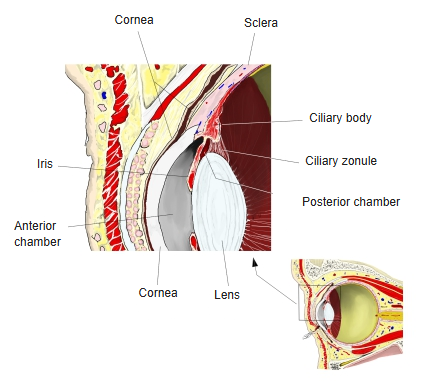
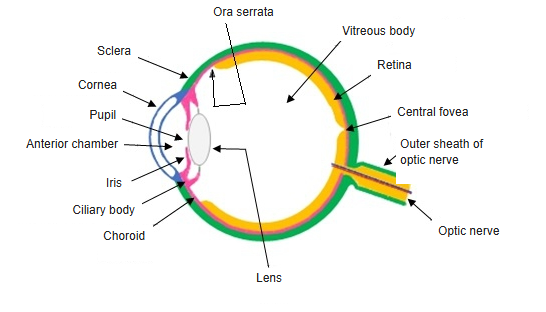
- The fluid-filled spaces in the front of the eyeball, between the cornea and the lens.
- The iris divides them into a larger anterior chamber and a narrow posterior chamber; they communicate through the pupil.
- Both are filled with aqueous humor; the space behind the lens filled by the vitreous body is sometimes called the vitreous chamber.
- Blocked drainage of the aqueous humor raises the intraocular pressure (glaucoma).
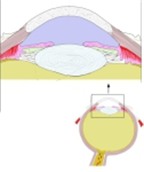
Anterior and posterior chambers 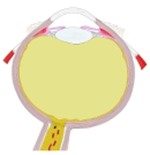
Right eyeball, horizontal section (model)
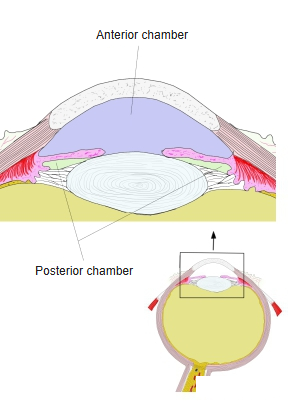
Anterior and posterior chambers
| Chamber | Boundaries | Features |
|---|---|---|
| Anterior chamber | Front: cornea. Back: iris and, in the pupil, the lens | About 3 mm deep in the centre (varies between people); at its periphery is the iridocorneal angle, where the aqueous humor drains |
| Posterior chamber | Front: iris. Back: lens and ciliary zonule. Side: ciliary processes | A narrow ring-shaped space where the aqueous humor is produced |
Front of the eyeball, sagittal section 
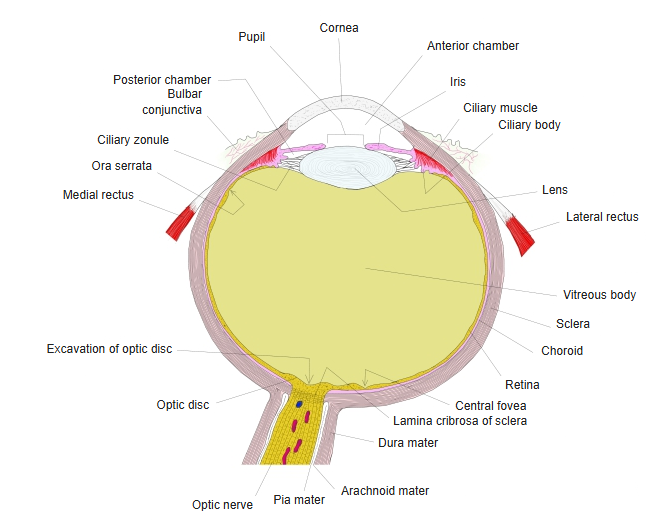
Eyeball, horizontal section (diagram)
References and sources
- Further reading: Chambers of eyeball, Wikipedia.