Latin: pili
Overview
- Flexible threads of keratinized cells, formed in hair follicles of the skin.
- Found on almost all of the skin except the palms, soles, lips, nipples and parts of the external genitalia.
- Functions: protection (scalp, eyebrows, eyelashes, nostrils), heat insulation and touch (nerve endings around the follicles).
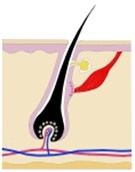
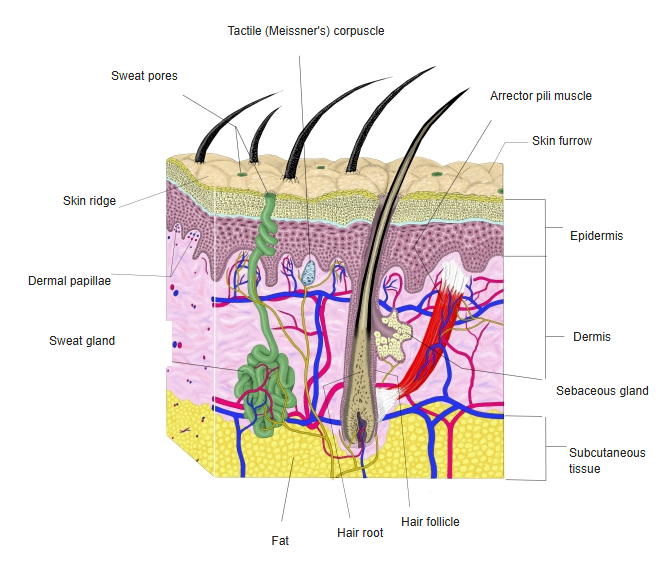
Hair and hair follicle 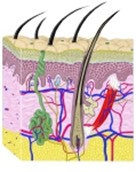
Skin, block diagram
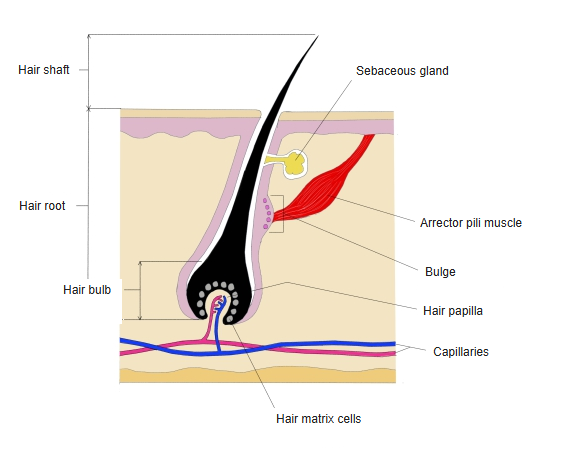
Parts of a hair
- Hair shaft: the part above the skin surface.
- Hair root: the part inside the follicle; it ends in the swollen hair bulb.
- The bulb is indented from below by the hair papilla (connective tissue with capillaries), which nourishes the hair matrix cells that produce the hair.
- The arrector pili muscle (smooth muscle) runs from the follicle to the dermis; its contraction raises the hair ("goose bumps") and squeezes the sebaceous gland.
Structure in cross-section
| Layer | Description |
|---|---|
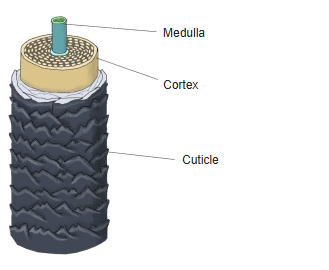
| Medulla | Central core of loosely packed cells and air spaces; absent in fine hairs |
| Cortex | Main bulk; hard keratin and the pigment that gives hair its colour |
| Cuticle | Single layer of thin overlapping scales on the surface |
Structure of a hair
Types and growth
- Lanugo: fine hair of the fetus. Vellus hair: short, fine, pale hair of most of the body. Terminal hair: long, thick, pigmented (scalp, eyebrows, and after puberty axillary and pubic hair).
- Hairs grow in cycles: growth (anagen, several years on the scalp), regression (catagen) and rest (telogen), after which the hair is shed.
- Scalp hair grows about 1 cm a month.
References and sources
- Further reading: Hair, Wikipedia.