Latin: lens
Overview
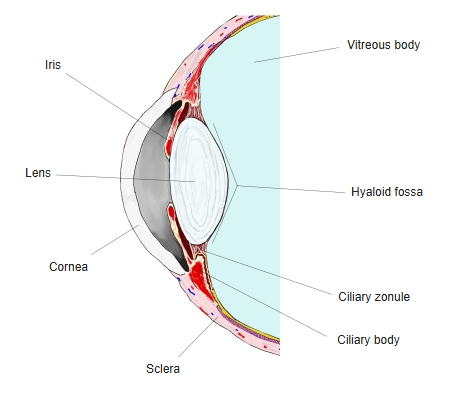
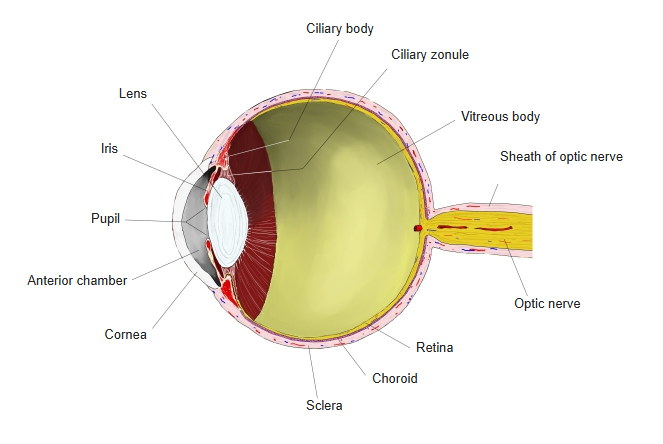
- A transparent, biconvex disc behind the iris and pupil and in front of the vitreous body, which it presses into (hyaloid fossa).
- Held at its equator by the ciliary zonule from the ciliary body.
- Fine-tunes the focus: it becomes rounder for near vision (accommodation); refractive power about 18–20 dioptres at rest, about one-third of the eye's total.
- Has no blood vessels or nerves; it is nourished by the aqueous humor.
Lens in place, section 
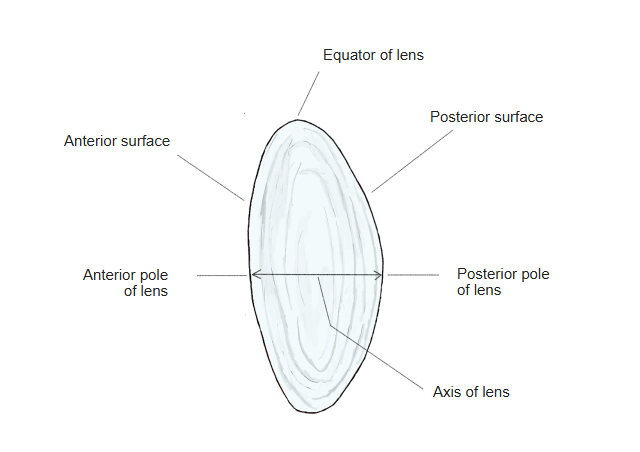
Lens: surfaces, poles and axis
Shape and size
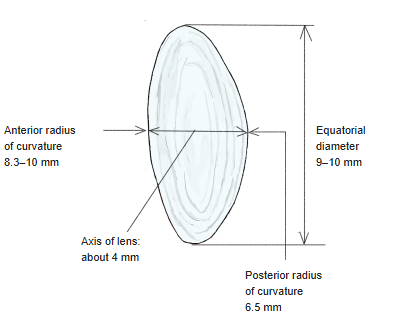
- Equatorial diameter about 9–10 mm; axial thickness about 4 mm, increasing with accommodation and with age.
- The anterior surface is flatter (radius of curvature about 10 mm) than the posterior surface (about 6 mm).
- The centres of the two surfaces are the anterior and posterior poles; the line joining them is the axis.
- Refractive index about 1.4, higher in the nucleus than in the cortex.
Size of the lens
Structure
| Part | Features |
|---|---|
| Lens capsule | Elastic basement membrane that encloses the lens; the zonular fibres attach to it |
| Lens epithelium | Single layer of cells under the anterior capsule only; at the equator its cells keep forming new fibres |
| Lens fibres | Long, transparent cells without organelles, full of crystallin proteins; they meet at Y-shaped lens sutures |
| Cortex and nucleus | Younger fibres form the softer cortex; the oldest, central fibres form the denser nucleus |
- About 65% water and 35% protein – the highest protein content of any tissue.
Eyeball, longitudinal section
Changes with age
- Rounder in children; flatter, larger and less elastic with age, so near focusing becomes difficult (presbyopia).
- Gradually turns yellowish; clouding of the lens is a cataract, treated by replacing the lens contents with an artificial lens.
References and sources
- Further reading: Lens, Wikipedia.