Latin: labyrinthus membranaceus
Overview
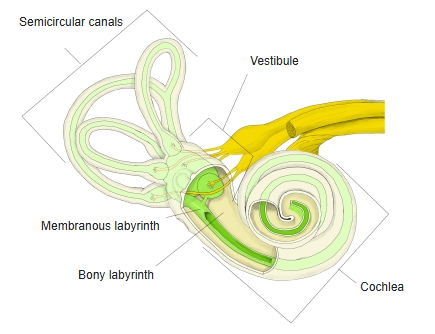
- The closed system of ducts and sacs inside the bony labyrinth; it contains the sensory cells for hearing and balance.
- Filled with endolymph (rich in potassium) and surrounded by perilymph (similar to cerebrospinal fluid).
- All its parts communicate with each other; the endolymph drains through the endolymphatic duct to the endolymphatic sac under the dura mater.
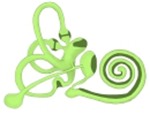
Membranous labyrinth 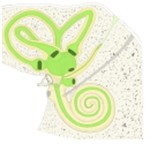
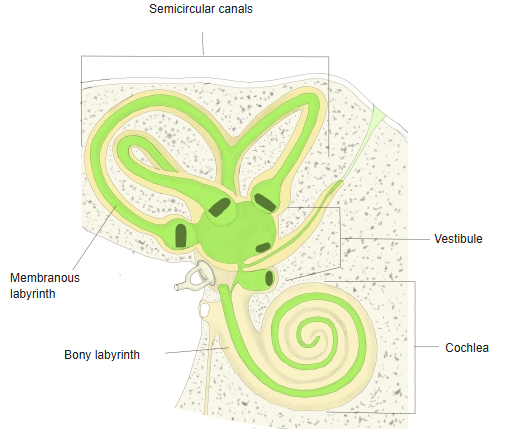
Bony and membranous labyrinth (section)
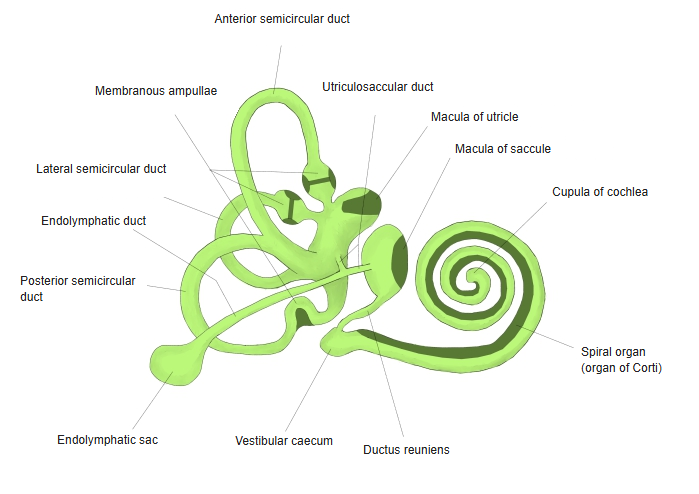
Parts
| Part | Location | Sensory area |
|---|---|---|
| Utricle | Vestibule (upper back part) | Macula of utricle |
| Saccule | Vestibule (lower front part) | Macula of saccule |
| Semicircular ducts | Semicircular canals; open into the utricle | Ampullary crests |
| Cochlear duct | Cochlea; joined to the saccule by the ductus reuniens | Spiral organ |
| Endolymphatic duct and sac | Vestibular aqueduct and posterior surface of the petrous bone | – (absorbs endolymph) |
- The utricle and saccule are linked by the utriculosaccular duct, from which the endolymphatic duct arises.
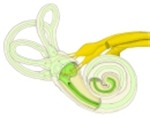
Bony and membranous labyrinth 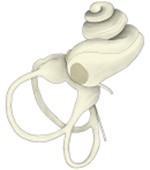
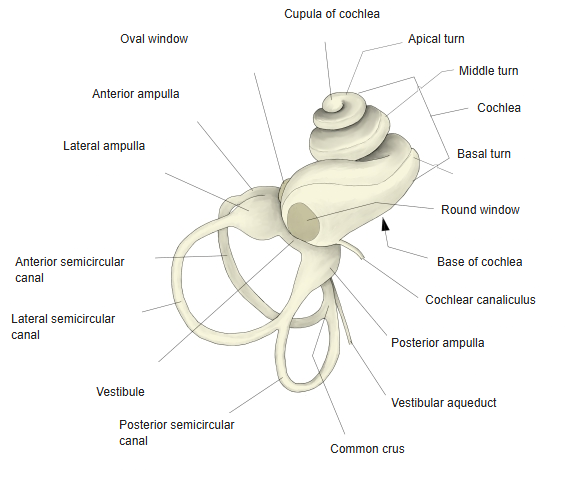
Right bony labyrinth
References and sources
- Further reading: Membranous labyrinth, Wikipedia.