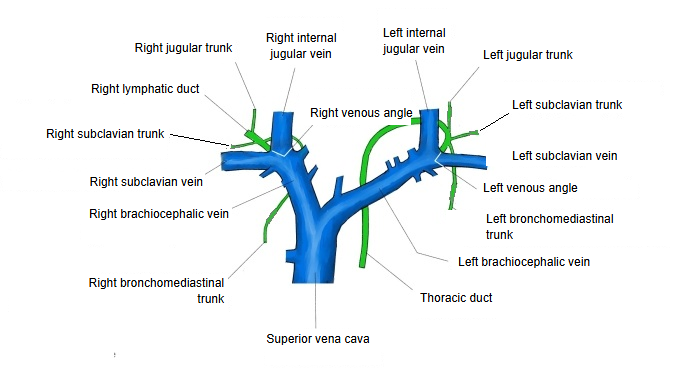
Venous angle (Latin: angulus venosus)
Also called Jugulosubclavian junction or Pirogoff's angle
- Overview
- Reference websites
- (Wikipedia, websites with illustrations)
- Where it is found
- Related terms
Overview
· Each venous angle lies behind the medial end of the clavicle, near the sternoclavicular joint.
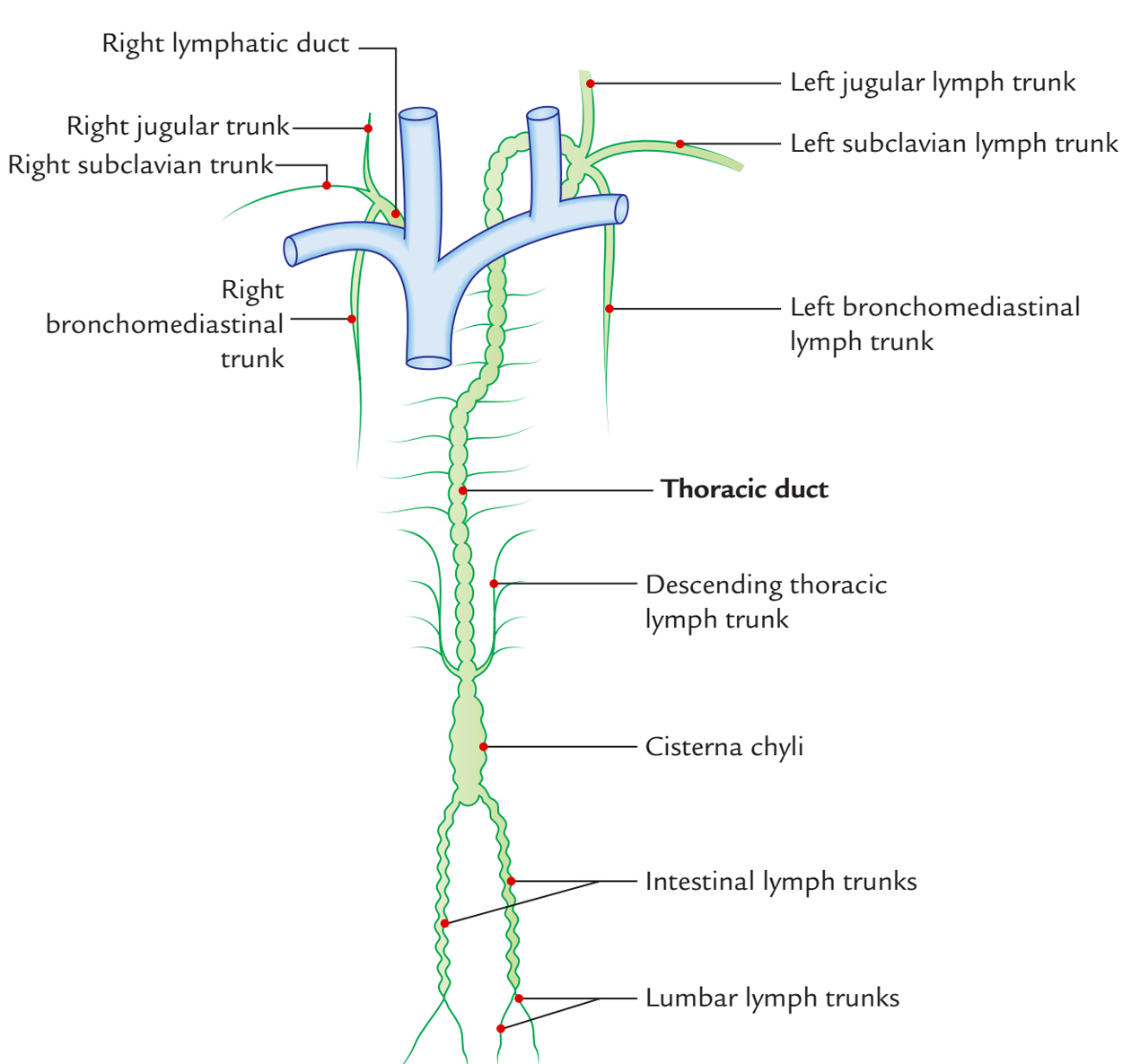
· The right lymphatic duct drains the right side of the head, neck and thorax and the right upper limb; the thoracic duct drains the rest of the body.
· The jugular, subclavian and bronchomediastinal lymph trunks join these ducts or open separately into the veins at or near the angle.
· Lymph nodes near the left venous angle (the left supraclavicular nodes) may enlarge when cancer of the abdominal organs spreads through the thoracic duct.
Sources differ on the exact openings: the terminations of the ducts and lymph trunks vary a great deal, and either duct may open by several channels into the internal jugular, subclavian or brachiocephalic vein.
Reference websites
[Wikipedia]
· Venous angle, Wikipedia.
[Websites with illustrations]
· Thoracic duct and lymph trunks (figure) (Earth's Lab)
· Components of the lymphatic system (SEER Training (NCI))
Where it is found
Related terms
- Thoracic duct
- Internal jugular vein
- Subclavian vein
- Brachiocephalic vein
- Superior vena cava
- Sternoclavicular joint
References and sources
- Further reading: Venous angle, Wikipedia.
- Federative International Programme for Anatomical Terminology (FIPAT). Terminologia Anatomica, 2nd ed. (TA2), 2019.