Fundus of gallbladder (Latin: fundus vesicae biliaris; fundus vesicae felleae)
the
gallbladder
- Neck : the upper end, which continues into the cystic duct.
- Hartmann's pouch : a slightly widened part where the body passes into the neck (see infundibulum of gallbladder).
- Body : the large central part between the neck and the fundus.
- Fundus : the rounded, blind lower front end.
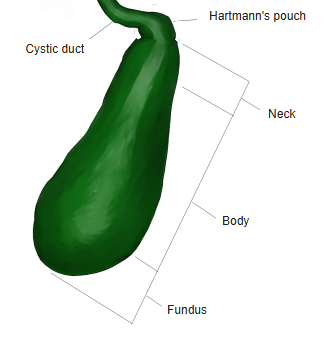
There are no sharp boundaries between the three parts.
· The fundus usually projects a little beyond the inferior border of the liver and touches the anterior abdominal wall, near the tip of the right 9th costal cartilage, where the lateral edge of the right rectus abdominis meets the costal margin.
· It is covered by peritoneum on all sides and lies in front of the beginning of the transverse colon.
· In acute inflammation of the gallbladder, pressing at this surface point while the patient breathes in causes pain and stops the breath (Murphy's sign).
A fold near the fundus can make it look like a cap folded over the body (the so-called Phrygian cap). This is a common normal variant.
Where it is found
Related terms
References and sources
- Further reading: Gallbladder, Wikipedia.
- Federative International Programme for Anatomical Terminology (FIPAT). Terminologia Anatomica, 2nd ed. (TA2), 2019.