Body of gallbladder (Latin: corpus vesicae biliaris; corpus vesicae felleae)
The body of the gallbladder is one of the three parts of the gallbladder: the large central part between the fundus and the neck.
Three parts: fundus, body and neck; the body is the largest of the three
Parts of
the
gallbladder
the
gallbladder
- Neck : the upper end, which continues into the cystic duct.
- Hartmann's pouch : a slightly widened part where the body passes into the neck (see infundibulum of gallbladder).
- Body : the large central part between the neck and the fundus.
- Fundus : the rounded, blind lower front end.
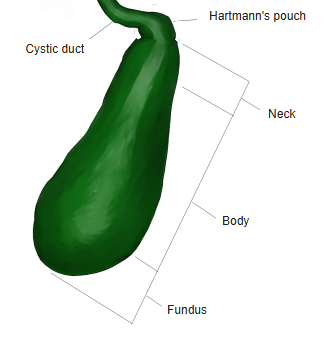
There are no sharp boundaries between the three parts.
· The body is the largest of the three parts. It runs from the fundus upwards, backwards and to the left, towards the porta hepatis.
· Its upper surface lies in the fossa for the gallbladder on the visceral surface of the liver, attached by connective tissue; its lower surface is covered by peritoneum.
· Below, it is related to the transverse colon and to the first and second parts of the duodenum.
· Its inner surface has a network of small mucosal folds that give it a honeycomb look.
Where it is found
Related terms
References and sources
- Further reading: Gallbladder, Wikipedia.
- Federative International Programme for Anatomical Terminology (FIPAT). Terminologia Anatomica, 2nd ed. (TA2), 2019.