Pyloric canal (Latin: canalis pyloricus)
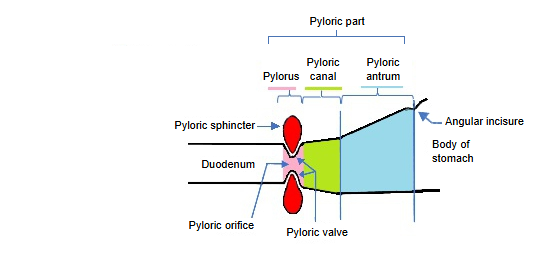
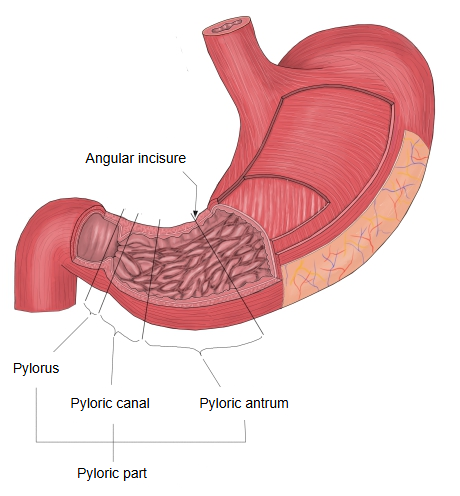
The pyloric canal is one of the parts of the pyloric part of the stomach: the last 2-3 cm of the stomach, just before the pylorus.
Pyloric part: the lower part of the stomach, leading to the duodenum. On this site it has three parts: the pylorus, the pyloric canal and the pyloric antrum
· There is no clear border between the pyloric canal and the neighbouring pyloric antrum.
· A shallow groove on the outside, the intermediate sulcus, sometimes marks the border.
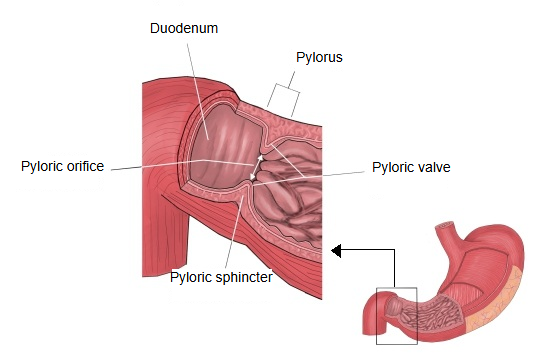
· Toward its end the circular muscle of the wall thickens to form the pyloric sphincter, which leads on into the duodenum.
· Sources differ: some treat the pylorus as the last part of the pyloric canal, so that the canal contains the sphincter; others, like this site, count the pylorus as a separate region after the canal.
Parts
of the
stomach
of the
stomach
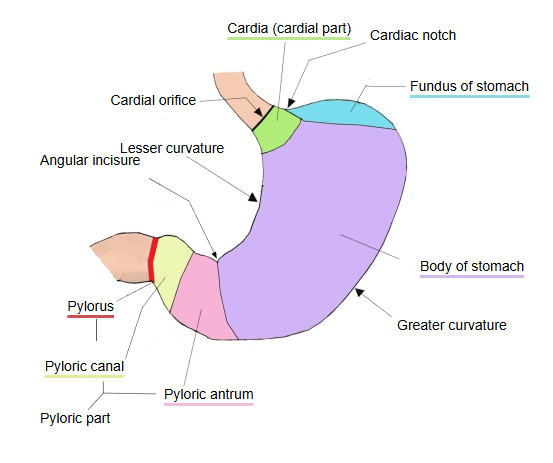
- Cardia : the area round the upper opening, where the oesophagus joins (cardial orifice, cardiac notch).
- Body : the large main part in the middle (with the gastric canal along the lesser curvature).
- Fundus : the part that bulges up and to the left of the body.
- Pyloric part : the lower part leading to the duodenum.
- Pylorus : the end of the stomach, at the junction with the duodenum: pyloric valve, pyloric sphincter, pyloric orifice.
- Pyloric canal : the last 2-3 cm of the stomach before the pylorus.
- Pyloric antrum : the wider part before the pyloric canal, bounded above by the angular incisure, where it meets the body.
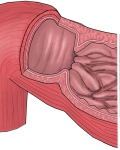 Pylorus (section)
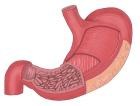 Pyloric part
Reference websites
[Wikipedia]
· Stomach, Wikipedia.
· Pylorus, Wikipedia.
[Websites with illustrations]
· Regions of the stomach (Wikimedia Commons)

· Stomach (Kenhub)
· The stomach (TeachMeAnatomy)