Pylorus (Latin: pylorus)
· It is the lower outlet of the stomach, leading into the duodenum. At the pyloric orifice a prominent fold, the pyloric valve, controls how fast chyme passes on into the duodenum and limits backflow of duodenal contents into the stomach.
· It is the lowest part of the stomach, with a strong ring of circular muscle, the pyloric sphincter. With the stomach empty and the body lying on its back, it lies about 1-2 cm to the right of the midline, in front of and to the right of the first lumbar vertebra, on the transpyloric plane; its position changes with posture and with how full the stomach is.
· The mucosa around the pylorus holds the pyloric glands, simple branched tubular glands that secrete mainly mucus; scattered G cells among them release the hormone gastrin.
· The prepyloric vein crosses the front of the pylorus and is used by surgeons as a landmark for the junction of the stomach and duodenum.
· Infantile hypertrophic pyloric stenosis is a thickening of the pyloric sphincter in young infants that blocks the emptying of the stomach and causes forceful vomiting.
of the
stomach
- Cardia : the area round the upper opening, where the oesophagus joins (cardial orifice, cardiac notch).
- Body : the large main part in the middle (with the gastric canal along the lesser curvature).
- Fundus : the part that bulges up and to the left of the body.
- Pyloric part : the lower part leading to the duodenum.
- Pylorus : the end of the stomach, at the junction with the duodenum: pyloric valve, pyloric sphincter, pyloric orifice.
- Pyloric canal : the last 2-3 cm of the stomach before the pylorus.
- Pyloric antrum : the wider part before the pyloric canal, bounded above by the angular incisure, where it meets the body.
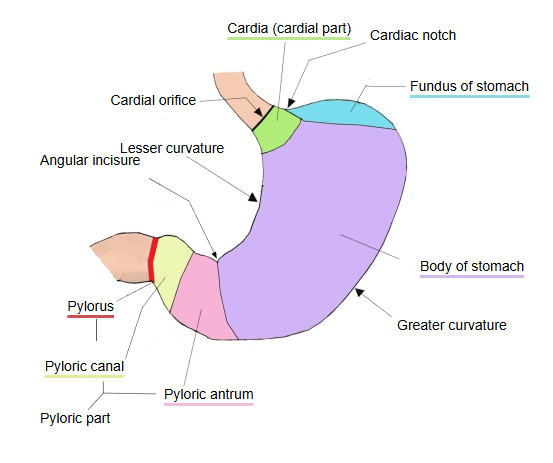
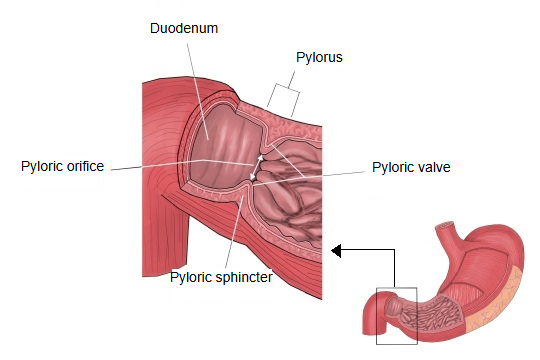
Pylorus and pyloric part
This site uses the following scheme.
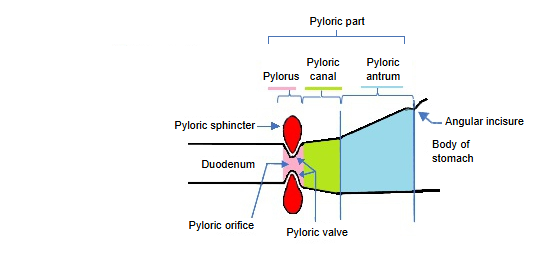
1. The pylorus is one part of the pyloric part.
The pylorus is the part where the stomach passes into the duodenum, with the pyloric sphincter and the pyloric valve.
The pyloric part, in contrast, is the wider region that also includes the stomach before the pylorus.
2. The pyloric part can be divided into two parts, the pyloric canal and the pyloric antrum (all sources agree on this).
3. The pyloric canal, part of the pyloric part, does not include the pyloric valve: it is the part just before the valve.
⇒ So the pyloric canal and the pylorus are different parts, and the pyloric canal lies just before the pylorus.
4. Therefore this site counts the pyloric part as pylorus + pyloric canal + pyloric antrum.
However, many sources (including Terminologia Anatomica) define the pyloric part as the pyloric canal + pyloric antrum only; some then count the pylorus as the last part of the pyloric canal, and others list it separately, after the canal. Some texts also use "pylorus" loosely for the whole pyloric part.
Reference websites
[Wikipedia]
· Pylorus, Wikipedia.
· Stomach, Wikipedia.
[Websites with illustrations]
· Stomach (Kenhub)
· The stomach (TeachMeAnatomy)
· Interior of the stomach (Gray's Anatomy) (Wikimedia Commons)
