Cardia (Latin: pars cardiaca gastris; cardia)
Also called the cardial part of stomach or the cardiac part
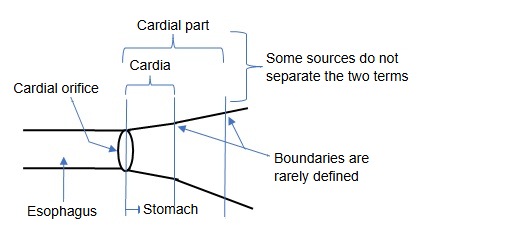
· In this wider sense, the region near the cardial orifice is called the cardial part. The name is sometimes limited to a small bulge marked off near the orifice, the cardiac antrum (an older term, not used in Terminologia Anatomica).
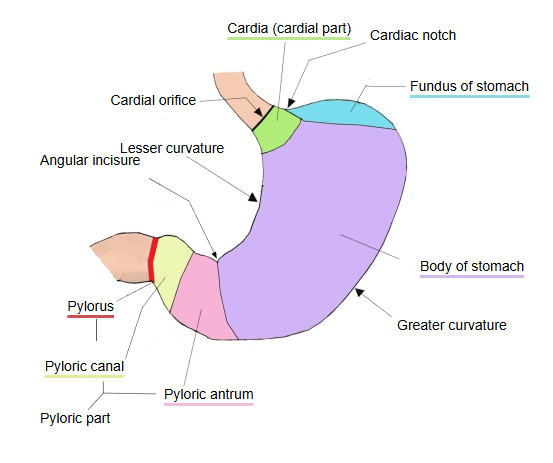
· The stomach is usually divided into four parts: the cardia (here not separated from the cardial part), the fundus, the body and the pyloric part.
· The cardial orifice lies to the left of the midline, behind the seventh left costal cartilage, at about the level of the T11 vertebra.
· On its left, the cardia is separated from the fundus by the cardiac notch, an acute angle between the esophagus and the fundus.
· Sources differ in how they use the terms: some use "cardia" for the cardial orifice itself, some for the narrow zone just below it (as in the figure), and others for the whole cardial part; the borders of these regions are seldom defined.
of the
stomach
- Parts of the sac
- Cardia : the area round the upper opening, where the esophagus joins (cardial orifice, cardiac notch).
- Body : the large main part in the middle (with the gastric canal along the lesser curvature).
- Fundus : the part that bulges up and to the left of the body.
- Pyloric part : the area round the lower opening, leading to the duodenum (pylorus, pyloric orifice, pyloric valve).
- Curvatures
- Greater curvature : the lower (left) border joining the cardia and the pylorus, where the front and back walls meet.
- Lesser curvature : the upper (right) border joining the cardia and the pylorus, where the front and back walls meet.
- Walls
- Anterior wall : the surface between the two curvatures that faces forwards and upwards.
- Posterior wall : the surface between the two curvatures that faces backwards and downwards.
About a sphincter at the cardia:
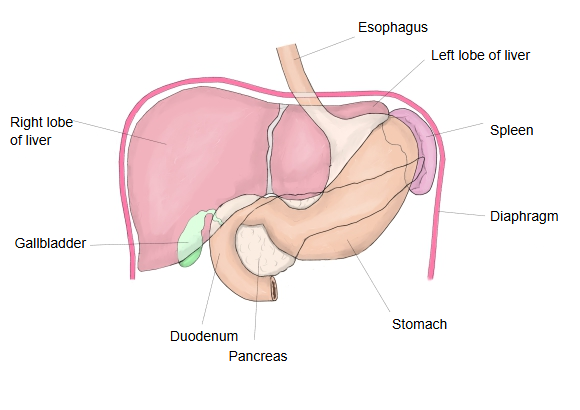
The cardia is where the abdominal part of the esophagus joins the stomach, but there is no special sphincter muscle layer there. Even so, there is little doubt that the cardia works to stop the contents of the stomach from flowing back into the esophagus.
· Reflux is limited instead by the lower esophageal sphincter (a physiological high-pressure zone at the end of the esophagus), the right crus of the diaphragm and the sharp angle at the cardiac notch.
· Histologically, the mucosa of the cardia contains mucus-secreting cardiac glands; this zone is only a few centimetres wide.
Reference websites
[Wikipedia]
· Stomach, Wikipedia.
[Websites with illustrations]
· Regions of the stomach (Wikimedia Commons)

· Stomach (Kenhub)
· The stomach (TeachMeAnatomy)