Bronchial cartilages (Latin: cartilagines bronchiales)
Also called the singular bronchial cartilage
· Bronchial cartilages are the pieces of cartilage in the wall of the bronchi that support them; they are made of hyaline cartilage.
of the
bronchus
- Bronchial cartilages : hyaline cartilage, like the tracheal cartilages, but they gradually become irregular and disappear towards the ends of the bronchial tree.
- Annular ligaments : continue from the trachea and join the C-shaped cartilages; where the cartilages become irregular plates they are no longer distinct.
- Mucosa : well developed and lines the lumen; it shows longitudinal folds where the smooth muscle contracts; the bronchial glands are fewer than the glands of the trachea.
- Membranous wall : continues from the trachea and closes the back of the main bronchi; it disappears where the C-shaped cartilages give way to irregular plates.
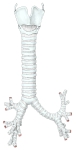 Trachea and bronchi (anterior view)
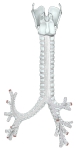 Trachea and bronchi (posterior view)
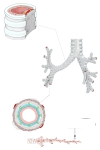 Change in the shape of the cartilage
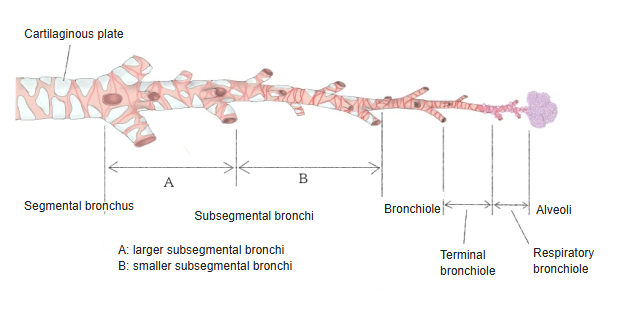
 Segmental bronchus to alveolar sac
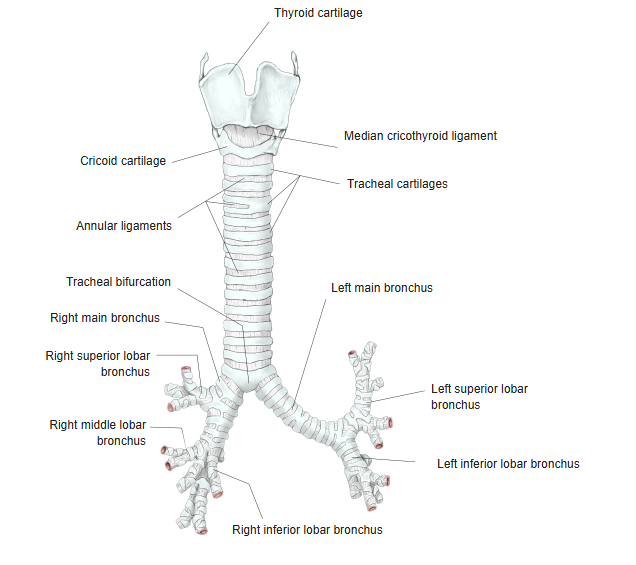
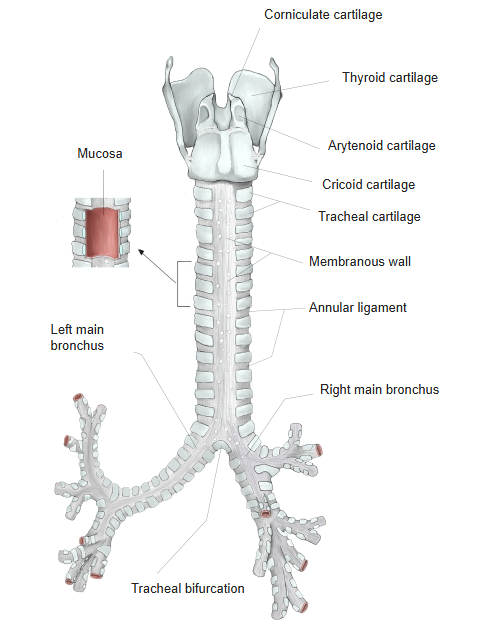
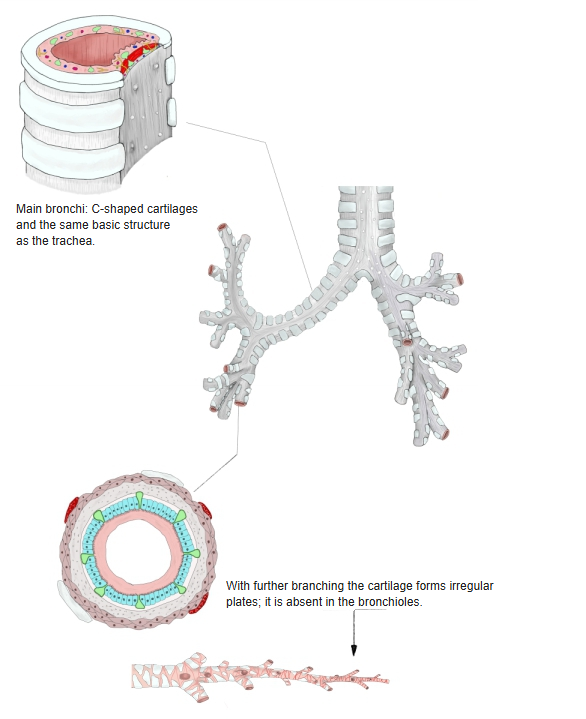
· In the main bronchi, C-shaped cartilages lie one above the other like the tracheal cartilages, joined by annular ligaments; the back wall, which has no cartilage, is the membranous wall (smooth muscle and fibrous tissue). The left main bronchus is longer than the right, so it has more cartilages.
· Inside the lung, where the bronchi divide into lobar bronchi, the membranous wall disappears and the cartilage becomes irregular plates and islands that surround the whole wall of the bronchus. Irregular cartilage plates are also found in the segmental bronchi.
· With each division the cartilage becomes smaller and less, and it is no longer seen in the bronchioles (about 1 mm or less across). As the cartilage decreases, smooth muscle develops instead and forms a spiral layer around the bronchus. The bronchial glands in the submucosa also become fewer and end at about the same level as the cartilage.
· The cartilage keeps the shape of the bronchi and holds the airway open, so that it does not collapse when the pressure around it rises, as in forced expiration or coughing. Weak or soft cartilage causes bronchomalacia.
More detail
· For the divisions and the whole structure of the bronchi, see the Bronchi page of the respiratory system; for the glands of the bronchial mucosa, see bronchial glands. The cartilage of the bronchi continues from the cartilage of the trachea at the tracheal bifurcation.
Reference websites
[Wikipedia]
· Bronchus, Wikipedia.
· Hyaline cartilage, Wikipedia.
[Websites with illustrations]
· A human bronchus under the microscope (cross-section) (Wikimedia Commons)

· Cartilages of the larynx, trachea and bronchi (Gray's Anatomy, fig. 961) (Wikimedia Commons)

· Bronchi and lungs (illustration) (Wikimedia Commons)

Where it is found
Related terms
- Bronchi
- Tracheal cartilages
- Bronchial glands
- Bronchiole
- Trachea
- Tracheal bifurcation
- Annular ligaments of trachea
References and sources
- Further reading: Bronchus, Wikipedia.
- Further reading: Hyaline cartilage, Wikipedia.
- Federative International Programme for Anatomical Terminology (FIPAT). Terminologia Anatomica, 2nd ed. (TA2), 2019.