Medial canthus (Latin: angulus oculi medialis)
Also called: medial angle of eye
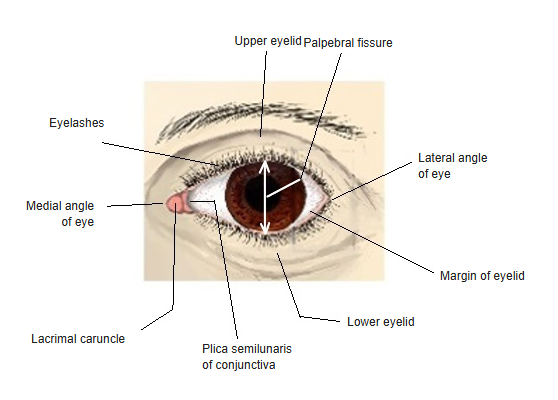
· It is the medial end of the palpebral fissure, the opening between the eyelids; the outer corner is the lateral canthus. Unlike the sharper lateral corner it is rounded and drawn slightly towards the nose, and it encloses a small space, the lacrimal lake, where tears collect. In the lake lies the lacrimal caruncle, a small pink mound of modified skin, and just lateral to it the plica semilunaris, a crescent-shaped fold of conjunctiva.
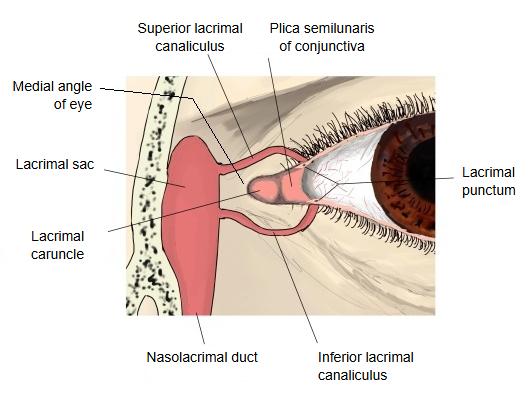
· It is the angle formed where the upper and lower eyelids join on the medial side. Near it each eyelid margin has a small opening, the lacrimal punctum; tears pass through the puncta and the lacrimal canaliculi to the lacrimal sac and on through the nasolacrimal duct to the nose. The medial palpebral ligament attaches the corner to the medial wall of the orbit, in front of the lacrimal sac.
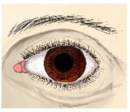 Eye and eyelids (front view)
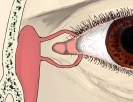 Medial canthus and tear ducts
Reference websites
[Wikipedia]
· Canthus, Wikipedia.
· Lacrimal caruncle, Wikipedia.
Where it is found
Related terms
- Eyelids
- Lacrimal apparatus
- Lacrimal sac
- Nasolacrimal duct
- Medial palpebral ligament
- Orbicularis oculi
- Angular vein
References and sources
- Further reading: Canthus, Wikipedia.
- Further reading: Lacrimal caruncle, Wikipedia.
- Federative International Programme for Anatomical Terminology (FIPAT). Terminologia Anatomica, 2nd ed. (TA2), 2019.